
What Is a Warehouse Management System? The Definitive Guide
From core definitions and feature breakdowns to ROI statistics, implementation best practices, and the AI-driven future of WMS — everything operations leaders need to know in 2026.
In This Guide
What Is a WMS?
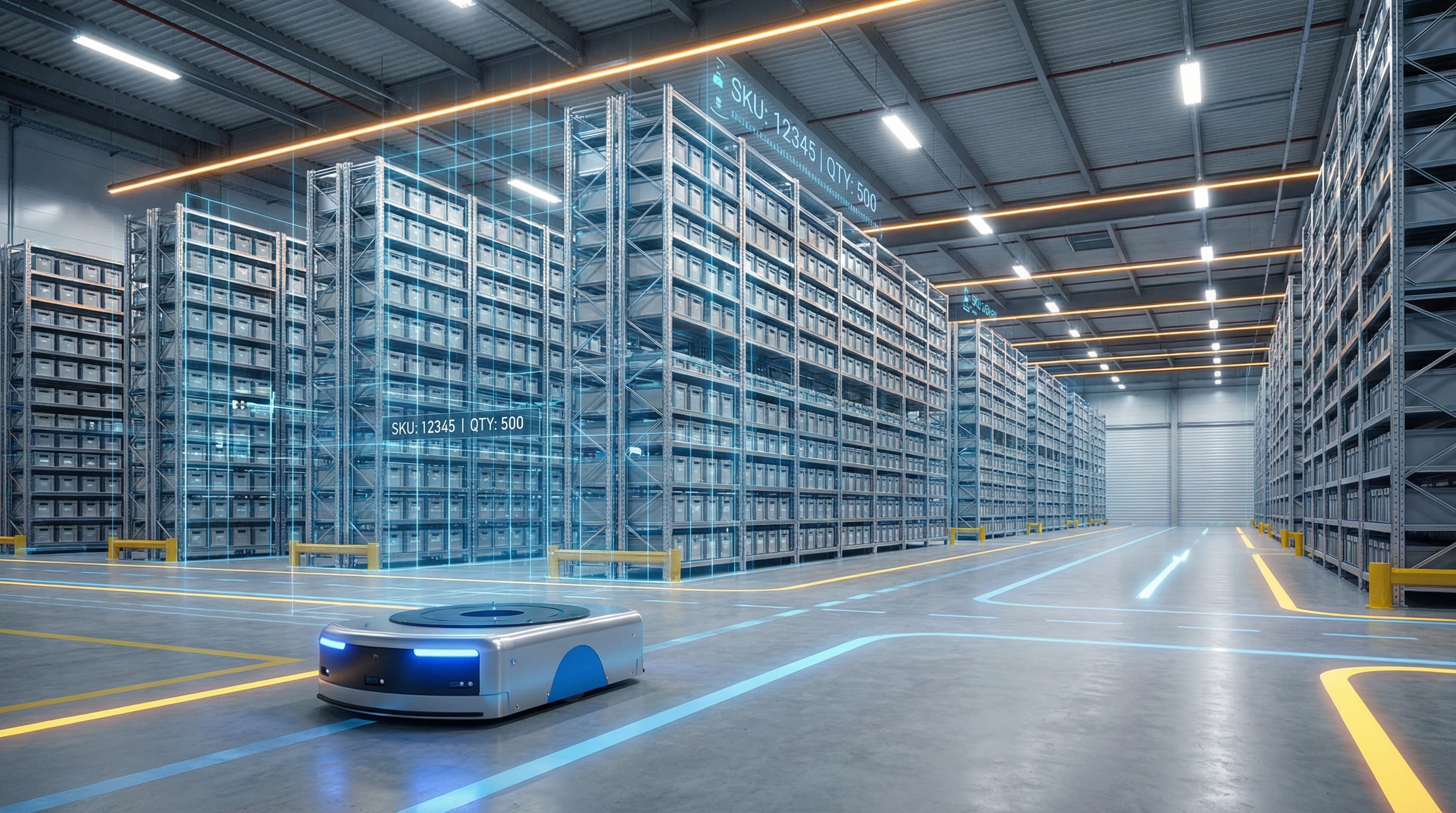
A Warehouse Management System (WMS) is a software application that provides centralized management and real-time visibility into every aspect of a warehouse’s operations. It orchestrates the entire lifecycle of goods within a facility — dictating how inventory is received, stored, picked, packed, and shipped. Think of it as the brain of the warehouse: directing both human labour and automated equipment to handle materials as efficiently as possible.
At its core, a WMS ensures goods and materials move through the warehouse in the most cost-effective way. It tracks what is in stock, where each item is located, and when replenishment is needed — all in real time. It uses algorithms to determine the best storage locations based on item dimensions, weight, and pick frequency, then assigns tasks to workers or robots to minimise travel time and maximise throughput.
The concept has evolved dramatically since the 1970s. Early warehouse systems were mainframe-based batch processors — little more than digital ledgers. The 1990s brought barcode scanning and RF terminals, giving birth to the true WMS. By the 2000s, deep ERP integration synced warehouse data with corporate accounting and sales. Today’s WMS platforms are cloud-native, AI-powered, and capable of directing fleets of autonomous robots alongside human workers.
The WMS sits at the intersection of three critical enterprise systems — ERP (finance and purchasing), OMS (customer orders), and TMS (freight and shipping) — acting as the operational bridge that ensures what was promised to the customer actually gets picked, packed, and delivered correctly.
The WMS Market in Numbers
The warehouse management system market is one of the fastest-growing segments in logistics technology. Driven by e-commerce acceleration, labour cost pressures, and the maturation of cloud software, WMS adoption is surging across every industry and geography.
Asia Pacific is the fastest-growing region, while manufacturing remains the largest industry segment at an estimated $3.2 billion by 2030. Retail and e-commerce, however, is the fastest-growing vertical — fuelled by consumer expectations for same-day and next-day delivery that have made manual warehouse operations a competitive liability.
In the UAE, the government has allocated up to $2 billion for logistics technology upgrades, and Dubai’s micro-fulfilment centres are being built to support sub-30-minute delivery windows. The Middle East WMS market alone is projected to nearly quadruple from $104–220 million in 2025 to $438 million by 2033.
Core Features & Functions
A modern WMS is far more than a digital inventory list. It is an intelligent orchestration platform that touches every warehouse process — from the moment a truck arrives at the receiving dock to the second a parcel leaves the shipping bay. Here are the seven core capability pillars.

Core
Inventory Tracking
IoT sensors and smart shelves create a digital twin of the warehouse with real-time stock visibility down to the bin level.
Order Management
Omnichannel fulfilment routes orders to the optimal location based on proximity, stock levels, and carrier cut-off times.
Picking Optimisation
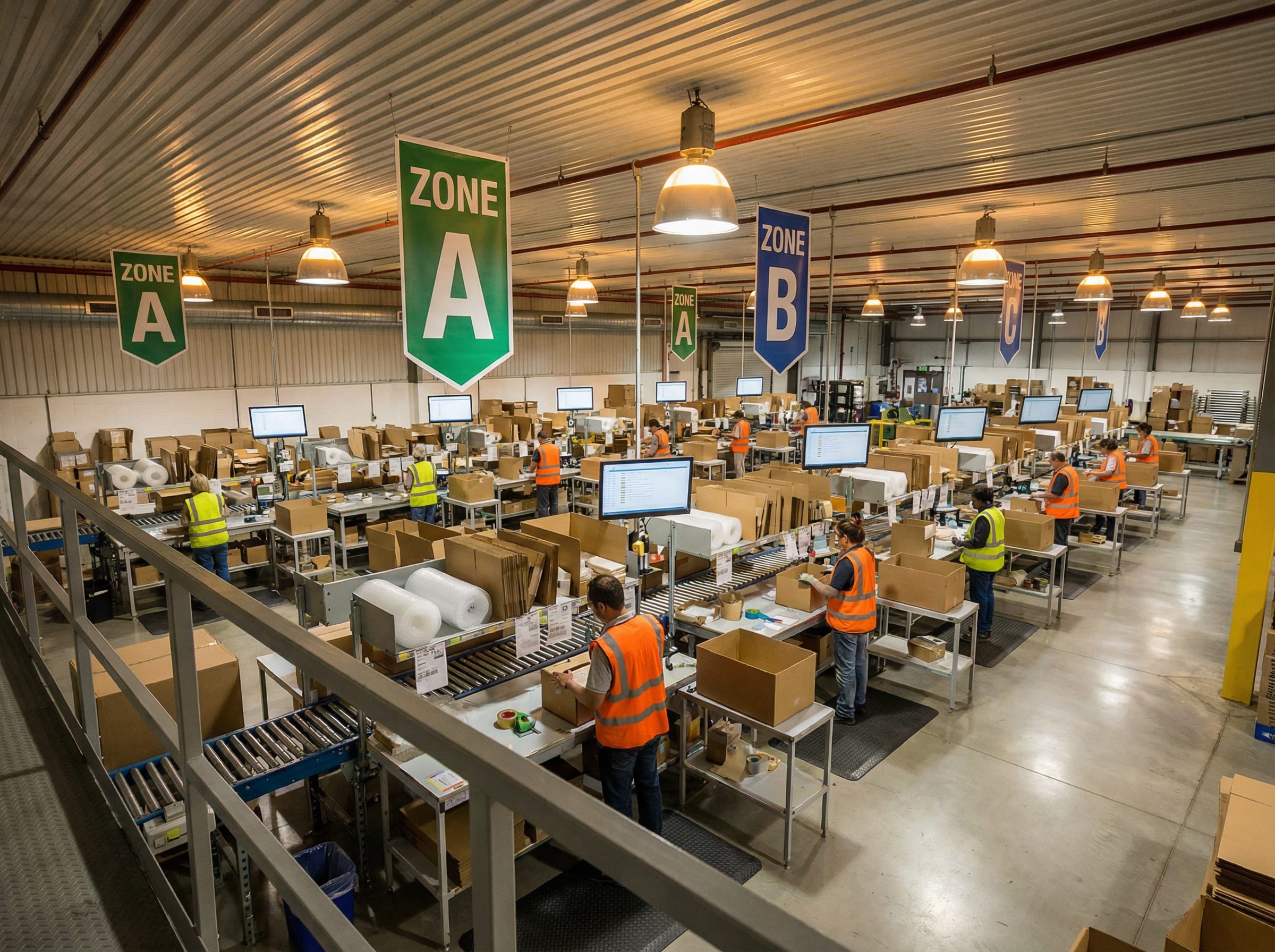
Algorithmic routing dynamically switches between wave, batch, zone, or cluster picking to minimise travel time.
Smart Putaway
AI determines optimal storage locations in real time based on item dimensions, weight, and predicted velocity.
Barcode & RFID
RFID portals register entire mixed pallets without manual scanning. Computer vision reads labels via overhead cameras.
Labour Management
Predictive staffing models, performance gamification, and wearable integration monitor productivity and worker safety.
The seventh pillar — reporting and analytics — ties all six together. Modern WMS dashboards monitor Overall Equipment Effectiveness (OEE) in real time, use predictive analytics to optimise workflows dynamically, and provide the data foundation for continuous improvement initiatives.
Types of WMS
Warehouse management systems come in three fundamental flavours, each suited to different operational scales and IT strategies. The defining trend of 2025–2026 is blurring boundaries — standalone systems are easier to integrate via cloud APIs, and ERP-based modules have vastly improved their execution capabilities.
| Criteria | Standalone (Best-of-Breed) | ERP-Integrated | Cloud SaaS |
|---|---|---|---|
| Depth of WMS features | ✓ Deepest | ● Good (improving) | ✓ Strong |
| Robotics integration | ✓ Native AMR/AS/RS | ● Via middleware | ✓ API-driven |
| ERP data flow | Requires integration | ✓ Seamless | API connectors |
| Deployment speed | 3–18 months | 6–18 months | ✓ Days to weeks |
| Upfront cost | High (millions for Tier 1) | High (ERP license + module) | ✓ Low (subscription) |
| Customisation | ✓ Unlimited | ● Within ERP framework | ● Config-driven |
| Best for | Large 3PLs, mega-warehouses | Enterprises with existing ERP | SMBs, fast-scaling e-commerce |
| Examples | Manhattan, Blue Yonder, Körber | SAP EWM, Oracle SCM, Dynamics 365 | ShipBob, Logiwa, SkuVault |
By Tier: Enterprise vs Mid-Market vs SMB
Tier 1 (Enterprise) systems like Manhattan Active WM and SAP EWM target Fortune 500 operations with budgets in the millions and implementation timelines of 9–18 months. Tier 2 (Mid-Market) solutions such as Made4net, Softeon, and Tecsys serve regional 3PLs with moderate budgets and 3–6 month rollouts. Tier 3 (SMB) platforms including ShipBob WMS and Zoho Inventory often cost less than $500 per month and deploy in days.
Open Source WMS
Open-source options like Odoo and ERPNext offer zero upfront licensing fees and ultimate customisation. However, they require a dedicated developer team for implementation, maintenance, and security — often exceeding the total cost of commercial alternatives. They also lack native integrations with advanced robotics and AI-powered picking optimisation.
Benefits & ROI
The business case for WMS is compelling and well-documented. SMBs implementing their first barcoding WMS can achieve positive ROI within just 6–9 months. Enterprise deployments typically see payback in 12–24 months with first-year returns ranging from 25% to 300%, depending on prior inefficiencies.
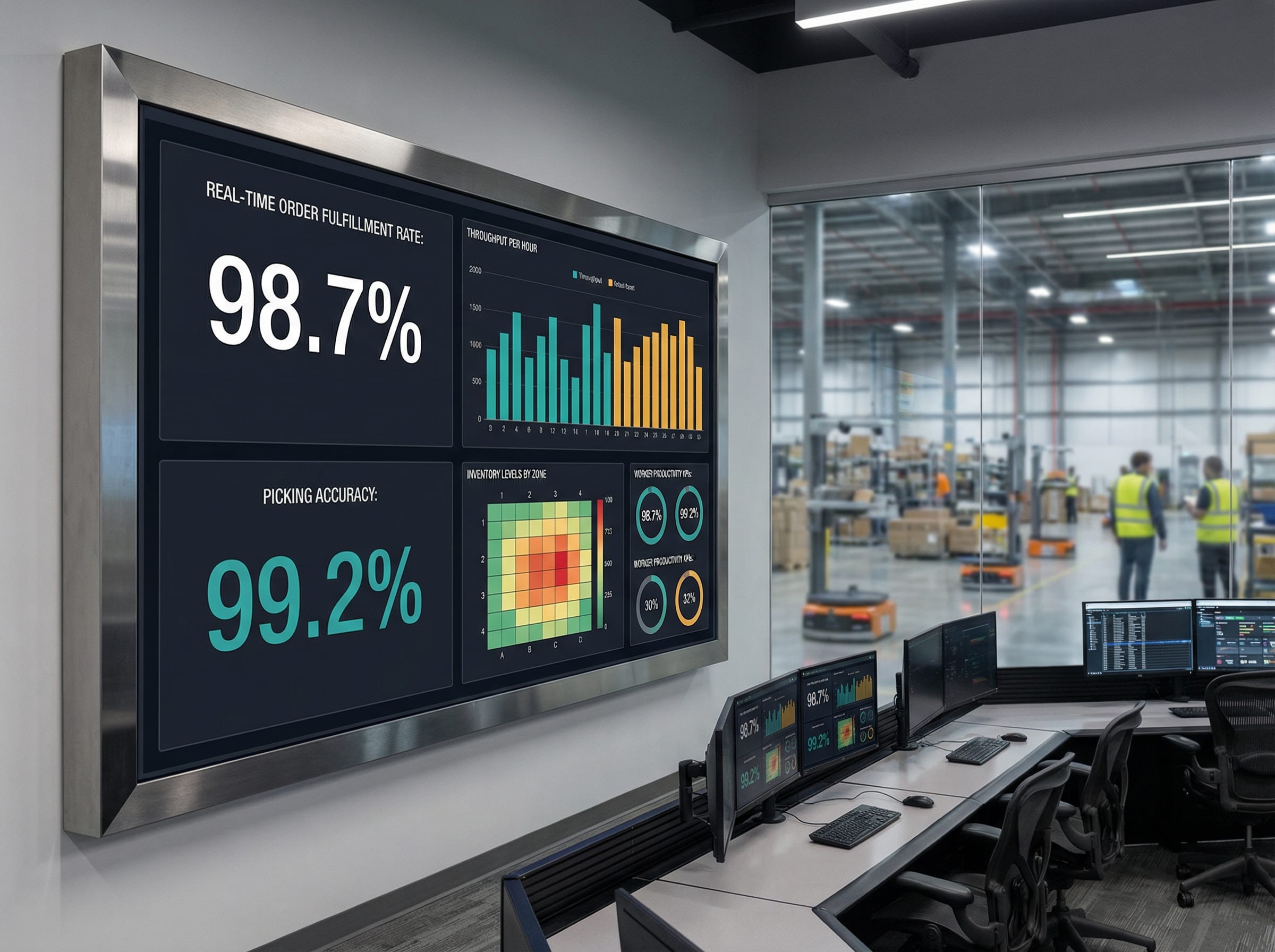
One of the most striking findings is the 1% accuracy rule: improving picking accuracy by just 1% increases retained revenue by up to 2%, because it eliminates costly returns, re-shipments, and customer churn. With automated pick accuracy approaching 99.15%, even small WMS-driven improvements translate into significant bottom-line impact.
Efficiency Gains Visualized
Beyond the headline statistics, here is how a WMS improves specific operational areas. These figures represent industry averages drawn from multiple deployment studies — actual results vary based on warehouse complexity, prior technology stack, and implementation quality.
How WMS Integrates with Your Stack
A WMS does not operate in isolation. It sits at the centre of the supply chain technology ecosystem, exchanging data with ERP, OMS, and TMS systems to create a single source of truth for inventory, orders, and shipments.
ERP
Finance, purchasing, item master
WMS
Warehouse orchestration
TMS
Freight, carriers, routing
OMS
Customer orders, inventory sync
The critical requirement in 2026 is cloud-native with open APIs. Whether you choose standalone, ERP-integrated, or SaaS, the system must support real-time bidirectional data exchange via REST/GraphQL APIs or iPaaS middleware. Batch-processed integrations — still common with legacy ERPs — create dangerous latency gaps between what the customer sees online and what is actually available on the shelf.
Implementation Best Practices
Even the most capable WMS fails if implemented poorly. The difference between a 6-month payback and a 3-year slog often comes down to preparation quality, scope discipline, and change management. Follow these eight proven practices.
Audit current workflows first
Map every receiving, putaway, picking, packing, and shipping process before touching software. Identify pain points, bottlenecks, and workarounds. You cannot optimise what you do not understand.
Cleanse data 60 days before go-live
Run rigorous cycle counts and a full item-dimensioning project. Poor data quality — inaccurate counts, missing SKU dimensions, duplicate records — is the number one cause of WMS implementation failure.
Choose cloud-native, API-first architecture
Multi-tenant SaaS delivers zero-downtime upgrades, lower CapEx, and rapid deployment. Avoid on-premise unless regulatory compliance demands it. Open APIs are non-negotiable for integration flexibility.
Follow the Crawl, Walk, Run strategy
Deploy core functions first (receiving, putaway, picking, shipping). Add advanced capabilities — wave planning, labour management, robotics integration — 3–6 months later. Trying to do everything on day one is a recipe for scope creep and staff burnout.
Invest in change management
Train “super users” who then train floor staff. Transitioning from paper-based processes to mobile scanners, voice picking, or AR glasses is as much a people challenge as a technology one.
Run phased rollouts, not big bang
Go live with one facility at a time, or inbound processes before outbound. This limits blast radius and gives the team real production experience before scaling.
Stress-test with a digital twin
Use high-volume simulation or a digital twin to model peak-season scenarios before go-live. Discover bottlenecks in software, not in reality.
Plan for 2–4 weeks of hypercare
Keep intense IT and operational support available after go-live. The first month in production always surfaces edge cases that testing missed.
The Future of WMS
The warehouse of 2030 will look nothing like the warehouse of 2020. Six converging trends are reshaping WMS from a transaction-processing system into an autonomous decision-making platform.

AI & Machine Learning
Demand sensing, dynamic slotting, and predictive labour planning that continuously learns from operational data and market signals.
Highest ImpactRobotics at Scale
An estimated 4 million commercial robots across 50,000+ warehouses by 2026. AMRs replacing fixed conveyors with sensor-driven flexibility.
Fastest GrowingDigital Twins
Virtual 3D warehouse replicas for simulating volume spikes, testing AMR routes, and modelling layout changes before physical implementation.
Strategic EnablerWMS-WES Convergence
WMS handles overarching inventory profiles; WES orchestrates minute-by-minute movements. The boundary between them is dissolving.
Architecture ShiftIoT & Autonomous Drones
IoT sensors cut equipment downtime 15–25%. Autonomous inventory drones replace manual cycle counts in high-density vertical storage.
OperationalGreen Warehousing
AI-driven optimisation reduces energy consumption via regenerative braking, dynamic climate controls, and solar-powered automated systems.
SustainabilityThe “dark warehouse” — a fully autonomous facility with minimal human intervention — is no longer science fiction. These facilities are already operational in e-grocery and cold-chain environments. But the dominant model for the next decade will be cobotics: human-robot collaboration where machines handle repetitive and physically demanding tasks while humans manage exceptions, quality control, and strategic oversight.
Frequently Asked Questions
What is the difference between WMS and ERP?
An ERP manages enterprise-wide processes (finance, HR, procurement), while a WMS focuses specifically on warehouse operations (receiving, storage, picking, shipping). Many ERPs include a WMS module, but standalone WMS platforms typically offer deeper warehouse-specific capabilities like advanced picking algorithms and robotics integration.
How much does a WMS cost?
Costs range dramatically by tier. Cloud SaaS solutions for SMBs start below $500/month. Mid-market systems run $50K–$250K for implementation plus monthly fees. Enterprise Tier 1 deployments can cost millions with 9–18 month rollouts. ROI typically appears within 6–24 months regardless of tier.
Can a small warehouse benefit from WMS?
Yes. Even a single-warehouse operation processing 50+ orders per day benefits from barcode-based inventory tracking, automated pick-list generation, and real-time stock visibility. Cloud SaaS platforms make WMS accessible to businesses that could never justify a traditional implementation.
What is the difference between WMS and WES?
A WMS handles strategic inventory management — what is in stock, where it goes, and what needs to ship. A Warehouse Execution System (WES) manages real-time task orchestration — directing robots, conveyors, and workers minute by minute. Modern platforms are merging both into unified systems.
How long does WMS implementation take?
Cloud SaaS platforms can be operational in days to weeks. Mid-market implementations take 3–6 months. Enterprise-scale deployments with robotics integration and multi-site rollouts require 9–18 months. The “Crawl, Walk, Run” approach is recommended regardless of scale.
Is WMS relevant for the UAE market?
Highly relevant. The UAE has allocated $2 billion for logistics technology, the Middle East WMS market is growing at 20% CAGR, and Dubai is building micro-fulfilment centres for sub-30-minute delivery. Solar-powered automated systems and AI climate control are being adapted for desert operating conditions.
What is a digital twin in warehouse management?
A digital twin is a real-time virtual replica of your physical warehouse, continuously updated by IoT sensors. It lets managers simulate scenarios — demand spikes, layout changes, new picking routes — before implementing them physically, turning warehouse management from reactive to predictive.
Will WMS replace warehouse workers?
WMS changes roles rather than eliminating them. Workers transition from repetitive physical tasks to technology supervision, quality control, and exception management. Facilities with advanced automation often require more staff in reliability, maintenance, and engineering roles — at higher skill and pay levels.
Let's talk scale.
Whether you're looking to optimize delivery, centralize operations, or unlock new revenue — Axiom X is your growth partner.
Our Headquarters
UAE