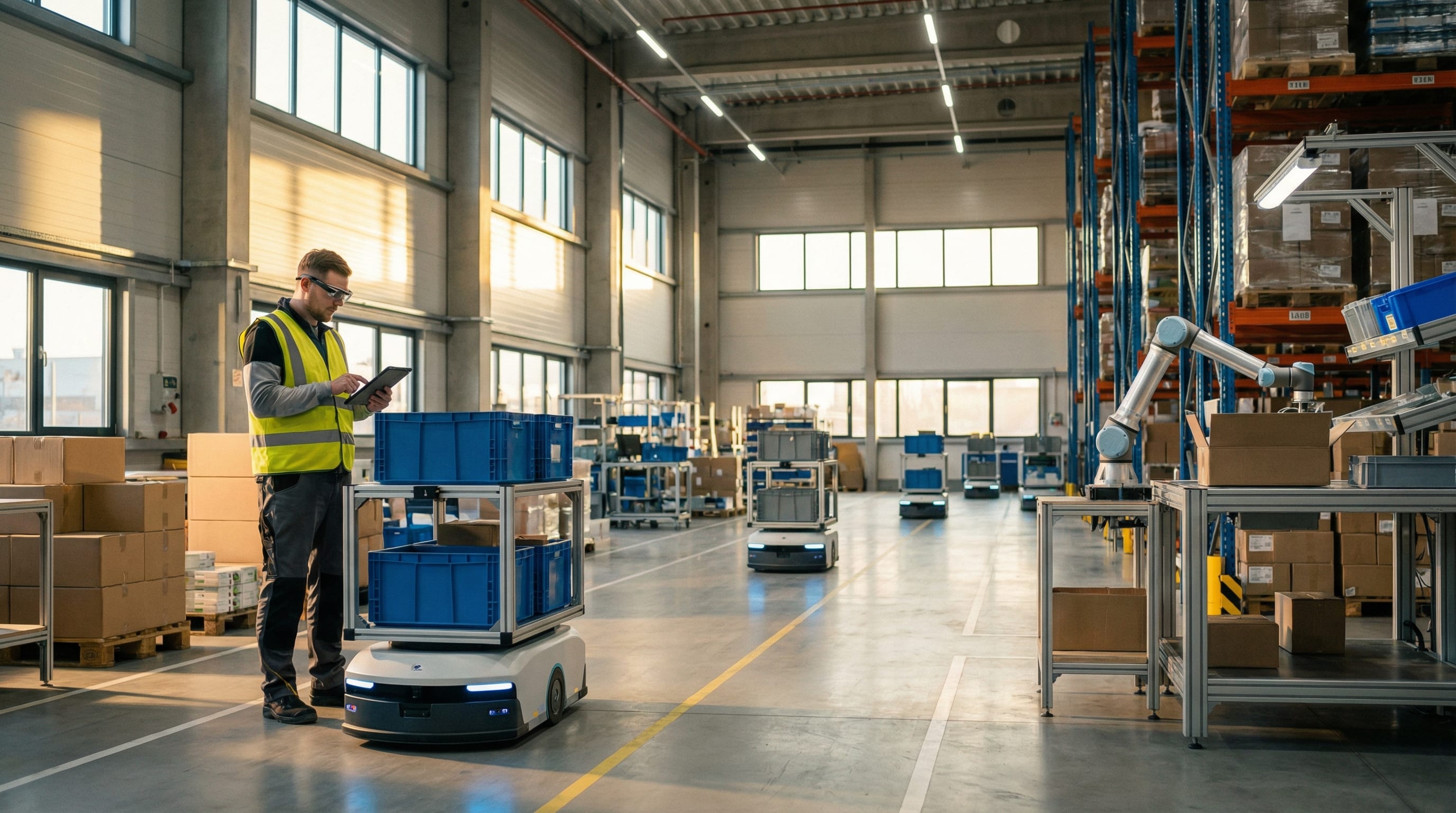
Modern automated warehouse with AMR robots and human workers collaborating alongside robotic arms
WAREHOUSE & TECHNOLOGY

The Complete Guide to Warehouse Automation

From AMRs and AS/RS to AI-powered WMS and digital twins — every technology, cost figure, and implementation step you need to automate your warehouse operations in the UAE and beyond.

Axiom Research Team April 3, 2026 22 min read

In This Guide

AX
Axiom X Team
Warehouse & Technology · April 3, 2026

What Is Warehouse Automation?

Warehouse automation is the use of technology — robotics, software, sensors, and intelligent systems — to perform warehousing tasks with minimal human intervention. It ranges from simple barcode scanners that digitize inventory tracking to fully autonomous facilities where robots pick, pack, and ship orders around the clock.

The key distinction is between fixed automation and flexible automation. Fixed systems — conveyors, sortation lines, and traditional AS/RS — deliver high throughput in stable, high-volume environments but require significant infrastructure changes. Flexible systems — AMRs, cobots, and Robotics-as-a-Service deployments — can be scaled up or down dynamically, reconfigured in days, and deployed without altering warehouse layouts.

In 2026, the industry is moving decisively toward flexible automation. Nearly 80% of warehouses globally still operate without advanced automation, representing a massive runway for adoption. The trigger is not technology curiosity — it is business necessity: e-commerce volumes, labor shortages, and customer expectations for same-day delivery have made manual operations a competitive liability.

“By end of 2026, an estimated 4.7 million commercial warehouse robots will be installed globally across more than 50,000 automated warehouses.”

— Industry Research Data, 2025–2026

The Market in Numbers

Warehouse automation is one of the fastest-growing sectors in global logistics. The numbers tell a story of accelerating adoption driven by e-commerce growth, labor cost pressures, and the maturation of robotics technology.

$29B+Global market size (2026)
15–18%Annual CAGR through 2032
$3.1BGCC market by 2030
80%Warehouses still manual

Automated Storage and Retrieval Systems (AS/RS) hold the dominant market share at approximately 30.5%, while AMRs are the fastest-growing hardware category. The UAE automation market is expanding at 13–17% CAGR, with the Automated Material Handling sub-sector showing exceptional growth of over 24% in 2025 alone. The GCC warehouse automation market, valued at $1.24 billion in 2024, is pacing toward $3.1 billion by 2030.

Core Technologies Explained

Modern warehouse automation is built on a diverse technology stack. Each component addresses a specific operational challenge. Understanding what each technology does — and where it fits — is essential before making investment decisions.

Autonomous Mobile Robots (AMRs)

Use LiDAR, SLAM, and AI for dynamic navigation. Highly scalable — drop new units on the floor during peak season without altering infrastructure. Over 1.3M RaaS deployments expected by 2026.

Fastest Growing

AS/RS Systems

Automated Storage and Retrieval Systems increase storage density by up to 400%. Range from mini-load cranes to high-density cube storage (e.g., AutoStore). 30.5% dominant market share.

Highest Density

Cobots (Collaborative Robots)

Safely operate beside humans without safety cages. Assist with picking, palletizing, and packaging. Low cost, easy to reprogram, and workers embrace them because they eliminate the hardest physical tasks.

Human-Friendly

Goods-to-Person (G2P)

Flips the traditional model: inventory bins are brought to stationary workers via AS/RS and AMRs. Reduces fatigue and triples picking speeds — accelerating fulfillment by up to 300%.

3x Picking Speed

Smart Conveyors

Deeply integrated with IIoT sensors for predictive maintenance. Energy-efficient motors idle when not in use. The backbone of high-throughput operations connecting warehouse zones.

High Throughput

Vision Systems & Pick-and-Place

Computer vision with 3D cameras and ML enables robots to recognize shapes, handle fragile items, and conduct quality inspections. AI-powered dexterity for piece-picking and sorting at high speed.

AI-Powered
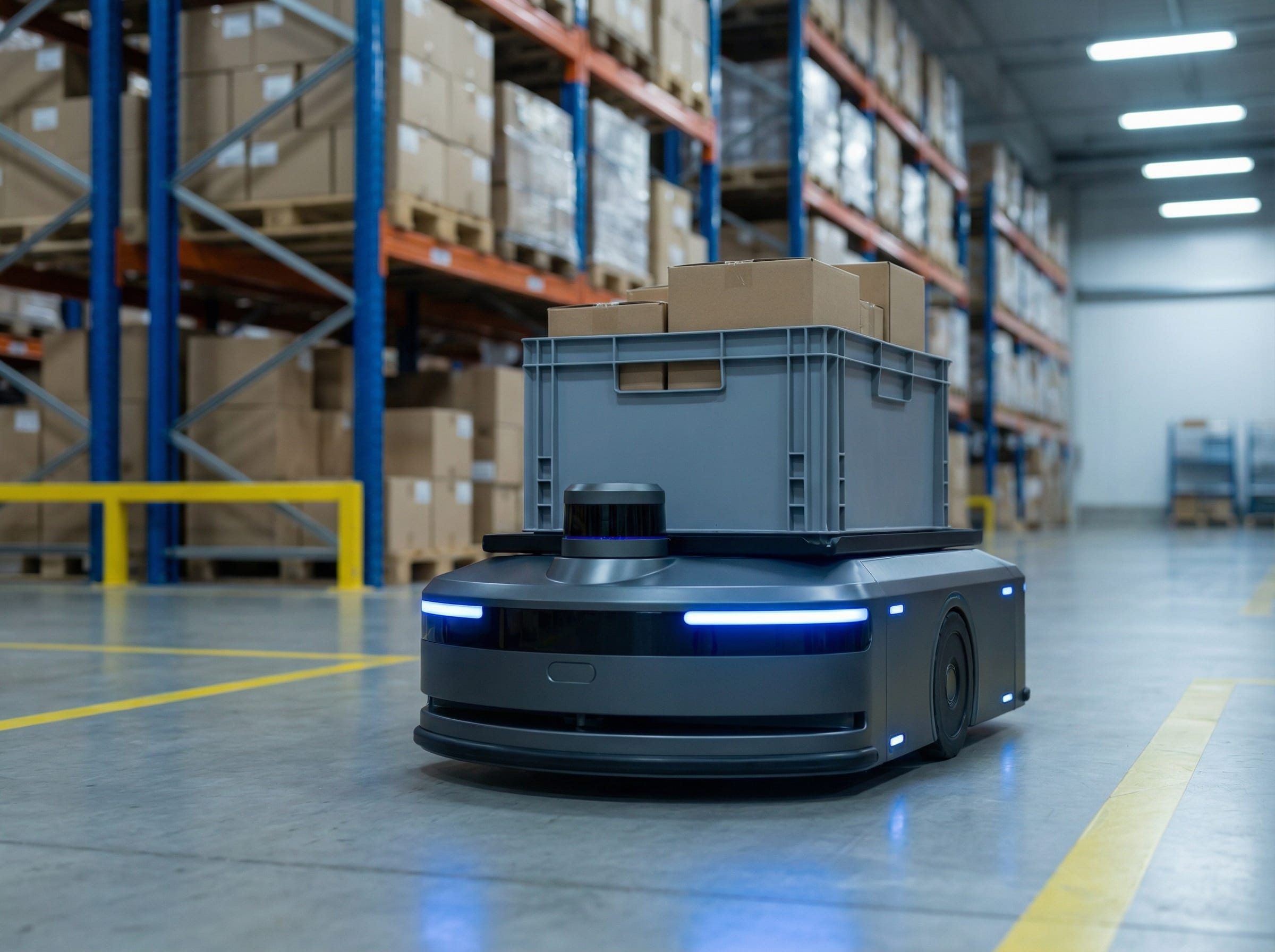
Autonomous mobile robot navigating a warehouse aisle carrying a loaded tote of goods
AMRs use LiDAR and SLAM navigation to move dynamically through warehouse aisles — no fixed tracks or magnetic strips required.

The Software & Intelligence Layer

Hardware does the heavy lifting, but software is the brain. The warehouse management system has evolved from a passive system of record into an intelligent, autonomous central nervous system that orchestrates every conveyor, robot, and human worker in real time.

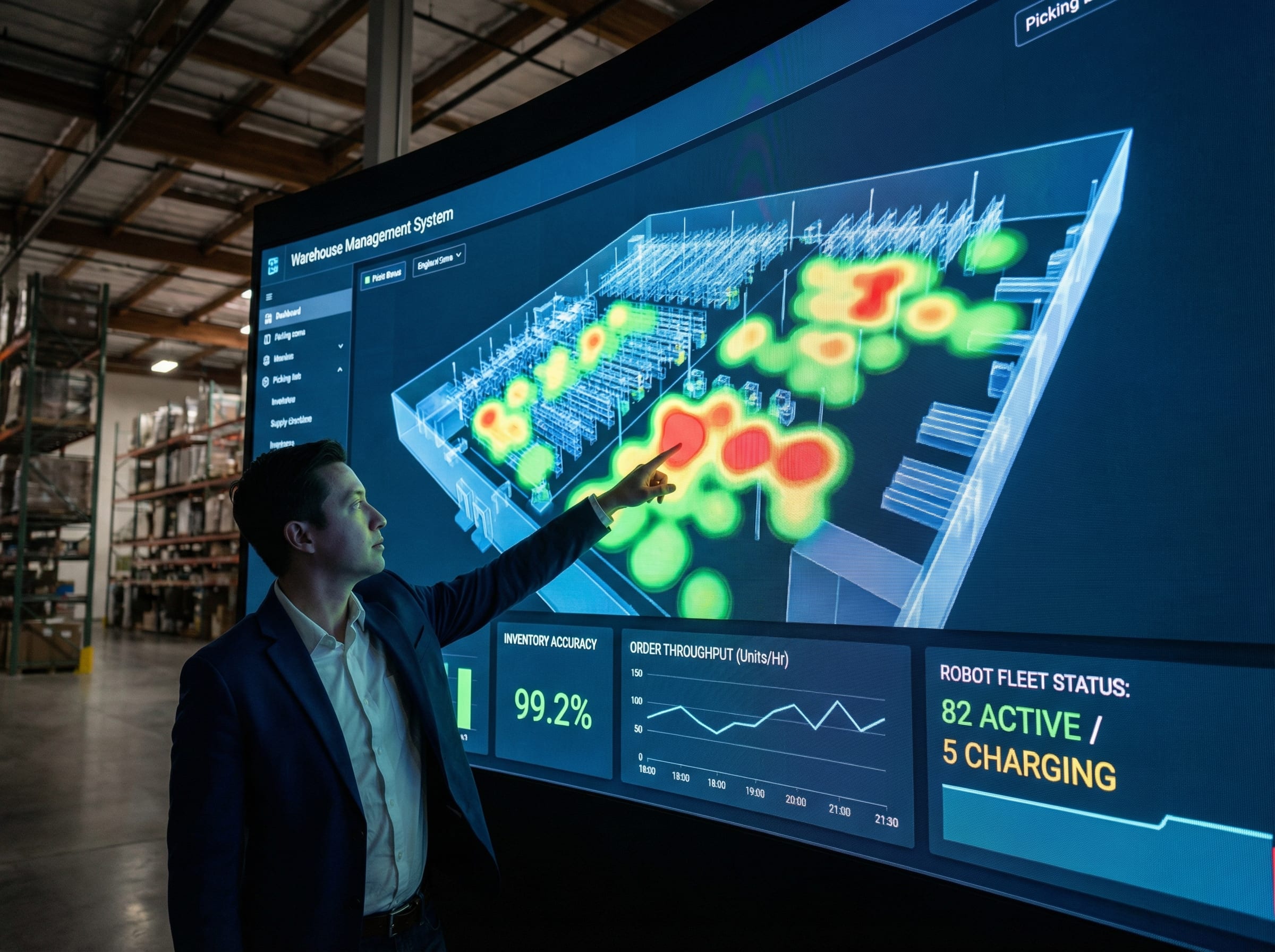
Warehouse management system dashboard with 3D digital twin visualization and heat maps

Digital Twins: The Virtual Warehouse

A digital twin is a 1-to-1 living virtual replica of the physical warehouse, continuously updated by IoT and RFID data. Managers simulate “what-if” scenarios: sudden 300% order spikes, new picking routes, layout rearrangements.

Heat maps overlay onto the twin showing traffic jams and bottlenecks in real time — turning reactive firefighting into predictive optimization.

TechnologyFunctionImpact
AI/ML ForecastingPredicts demand using historical sales, seasonal trends, social media sentiment, and weather patternsUp to 35% more accurate demand predictions
Dynamic SlottingAI continuously repositions inventory based on order velocity — viral products move closer to packing stationsReduces pick path distance by 20–40%
Predictive MaintenanceIoT sensors monitor vibration, acoustics, and temperatures; ML predicts part failures before they occurZero unplanned downtime
RFID (Next-Gen)Active and passive tags communicate with overhead readers, updating inventory by the second without manual scansEliminates barcode scanning lag
WES (Warehouse Execution)Orchestration layer between WMS and machine-level controls; allocates missions based on congestion and battery levelsCoordinates humans and robots in real time

ROI & The Business Case

The question is not whether warehouse automation pays off — it is how fast. Labor currently accounts for 50–70% of total warehousing budgets. Automation drives 25–30% immediate labor cost reduction, scaling to 40% over five years. Total deployment ROI regularly exceeds 250% when properly implemented.

01
AMR Purchase
$40K–$80K per unit outright, or $600–$900/mo via RaaS
02
Integration
WMS/WES connection, staff training, workflow redesign
03
Breakeven
12–24 months for AMRs; 4–6 years for full AS/RS
04
Scale ROI
250%+ total ROI; 30% efficiency gain in year one

Key Performance Improvements

  • Throughput: Goods-to-Person systems accelerate fulfillment by up to 300%; human-robot collaboration yields 30% efficiency gains in year one
  • Accuracy: Fulfillment errors drop by up to 70%; accuracy rates reach 99.15% to 99.99%
  • Error cost: Mis-picks cost up to $100 each — automation virtually eliminates them
  • RaaS advantage: 72% of logistics firms have transitioned to Robotics-as-a-Service, shifting CapEx to OpEx and achieving positive ROI 1–2 years earlier than outright purchases
Logistics executives reviewing warehouse automation ROI projections in a modern office overlooking warehouse floor
Building the business case for warehouse automation requires factoring in space utilization, injury reduction, and accuracy improvements — not just direct labor savings.

Case Studies: Amazon & DHL

Theory is one thing; results at scale are another. Two of the world’s largest logistics operators have published enough data to benchmark what automation actually delivers.

Amazon — 1 Million Robots Across 300+ Facilities

Mid-2025 milestone
Before Automation
  • Manual picking with long walk times
  • Higher error rates on complex orders
  • Limited throughput during peak seasons
  • Worker fatigue and injury risk
After Automation
  • 25–35% productivity boost in picking
  • Error rates dropped 40–50%
  • Workers handle 2–3x more units per hour
  • 20% faster delivery cycle
Key insight: Amazon’s next-gen fulfillment centers require 30% more staff in Reliability, Maintenance, and Engineering roles. Automation does not eliminate jobs — it creates new, higher-skilled ones. ROI on robotics deployments: 18–24 months.

DHL Supply Chain — Strategic Robotics Alliance

Robust.AI “Carter” partnership, 2026
Challenge
  • Scaling manual picking across global facilities
  • Inconsistent productivity across shifts
  • Need for sub-18-month payback on automation
Results
  • 60%+ order-picking productivity improvement
  • 2,000+ collaborative robots in EMEA alone
  • Task-specific automation hitting payback targets
Key insight: DHL prioritizes automating specific high-volume tasks first for sub-18-month paybacks before scaling. Their lesson: warehouses attempting to automate everything at once often fail to see immediate returns.

Warehouse Automation in the UAE

The UAE is not just adopting warehouse automation — it is being positioned by government policy as a global leader. Operation 300bn, the Ministry of Industry and Advanced Technology’s 10-year strategy, aggressively incentivizes Industry 4.0 adoption including smart factories and automated supply chains. Combined with the Dubai Industrial Strategy 2030 and “We the UAE 2031,” the regulatory environment is designed to accelerate automation investment.

“UAE e-commerce is anticipated to reach AED 30 billion, growing at 20% annually — the primary force pushing the country from manual to automated fulfillment at unprecedented speed.”

Free Zone Automation Hubs

JAFZA (Jebel Ali Free Zone): The Middle East’s dominant maritime trade hub is undergoing a massive transition to high-throughput automated distribution centers. IQ Robotics deployed 130+ AMRs for Brands for Less Group’s facility, and heavy investment is flowing into AS/RS for temperature-controlled pharmaceuticals and FMCG.

Dubai South: A testing ground for next-gen automation. The zone hosted the UAE’s first autonomous vehicle cargo trials (partnership with Evocargo) and is integrating IoT sensors, AMRs, and automated customs clearance. Solar-powered cooling and ESG-compliant green warehousing are becoming the standard.

DAFZA (Dubai Airport Freezone): Focused on ultra-fast e-commerce fulfillment and air freight, DAFZA is deploying matrix sorting systems and advanced conveying infrastructure that reduce labor dependencies by up to 60% with sorting accuracies of 99.9%.

A notable development is “Namla” — a UAE-manufactured automated radio shuttle system by Acme Intralog, marking the emergence of a “Made in the UAE” automated warehousing brand.

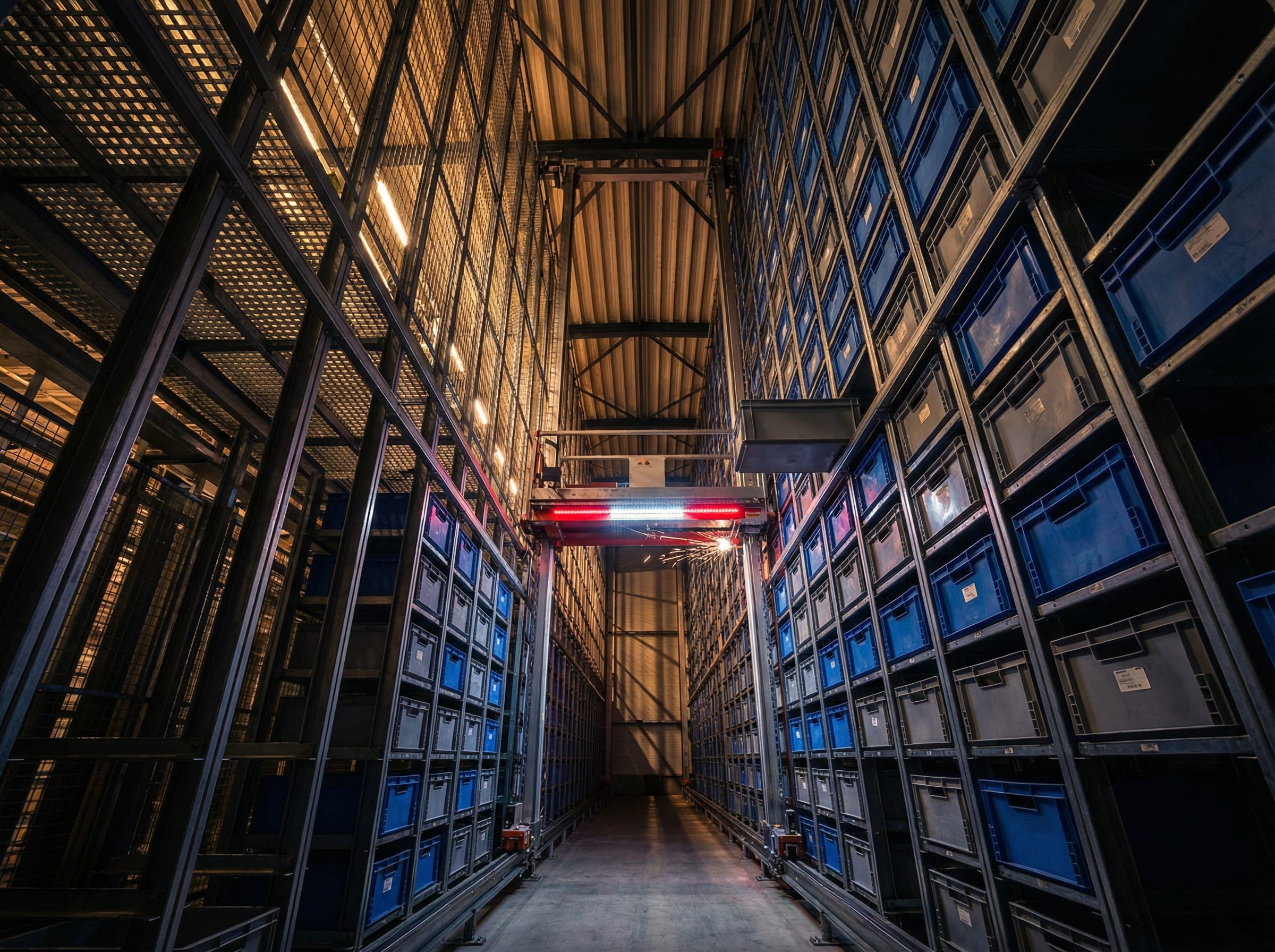
Interior of a high-bay automated storage and retrieval system with towering racking and robotic crane shuttle
AS/RS systems in UAE free zone warehouses can increase storage density by up to 400% — critical for maximizing the value of premium free zone real estate.

The Crawl, Walk, Run Roadmap

The cardinal rule of warehouse automation: do not automate a broken process. Before deploying any technology, document current workflows, identify bottlenecks, and clean your inventory data. Then follow this phased approach.

01
Crawl: Digital
Connect ERP and WMS. Implement barcode scanning, voice picking, wearable tech. No robotics yet.
02
Walk: Targeted
Deploy AMRs for one constrained process. Install Vertical Lift Modules. Cobots join the team.
03
Run: Orchestrate
Full WES integration. AI allocates missions dynamically based on congestion, availability, battery.

Vendor Selection Criteria (2026)

  • Reliability over novelty: Consistent uptime and predictable cycle times outweigh experimental features. Choose vendors with mature diagnostics and robust service networks
  • RaaS flexibility: Scale robot fleets up during peak, down during lulls — avoid large upfront commitments until ROI is proven
  • Hardware-agnostic software: Orchestration platforms that communicate with multiple hardware brands. Avoid vendor lock-in at all costs
  • Robust APIs: Well-documented, low-code/no-code integration tools are increasingly standard. If a vendor cannot demonstrate clean API connectivity, move on

Change Management

Automation fails more often on people than technology. Transition workers from low-value physical tasks to robotics coordination, quality control, and exception management. Address “robot replacement” fears directly by explaining safety improvements, reduced physical strain, and upskilling opportunities. Design workflows around how humans and robots intersect — not as separate systems.

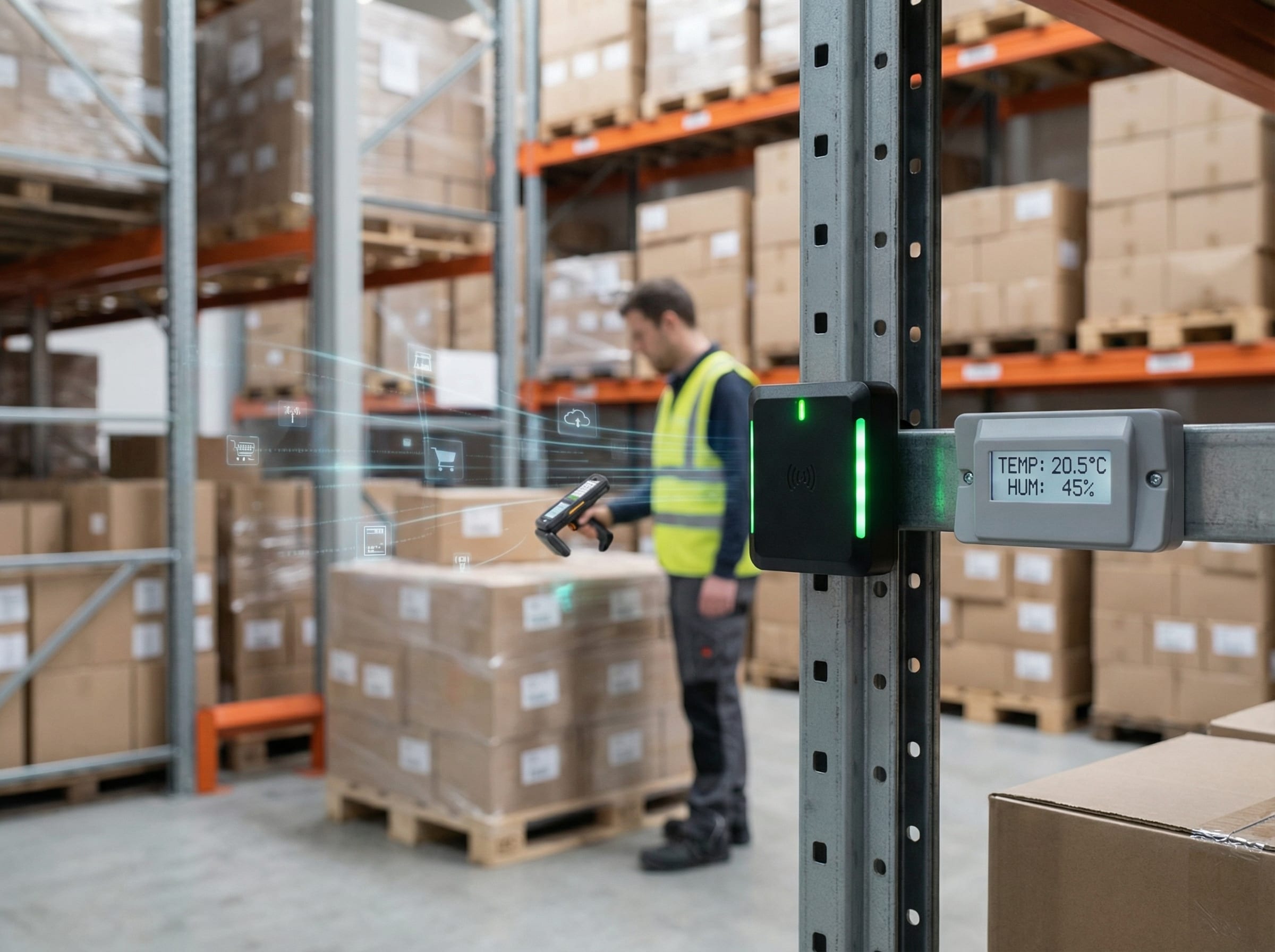
IoT sensors including RFID reader and temperature monitor mounted on warehouse racking with worker scanning in background
IoT sensor networks — RFID readers, temperature monitors, and humidity sensors — create the “glass pipeline” of real-time visibility that modern WMS platforms depend on.

Common Mistakes to Avoid

Warehouse automation projects fail not because the technology does not work, but because the implementation is flawed. These are the most expensive mistakes companies make — and how to avoid them.

!

“Islands of Automation”

Standalone robotic systems not connected to the WMS create localized efficiency but push bottlenecks downstream. Every automated system must feed data into and receive instructions from the central WMS/WES.

!

Underestimating Infrastructure

Companies forget about Wi-Fi density, 5G connectivity, electrical upgrades for charging docks, and floor condition requirements. AMRs need consistently flat, clean floors and strong wireless coverage. Budget for infrastructure alongside hardware.

!

Rigid Layouts for Changing SKUs

Bolting down permanent conveyor systems when your SKU mix changes frequently is a recipe for obsolescence. Modular, AI-driven flexible automation is the 2026 standard. Design for reconfigurability.

!

Neglecting Clean Data

Assuming AI and ML will fix poor inventory practices is the most common mistake. AI optimizes good data but cannot fix operational disorganization. Clean your inventory data before automating — not after.

!

Trying to Automate Everything at Once

DHL’s lesson: start with one high-volume task, prove the ROI, then expand. Companies that deploy facility-wide automation on day one struggle with integration complexity and delayed payback. Crawl, walk, run.

Key Takeaways

What You Need to Remember

  • The global warehouse automation market exceeds $29 billion in 2026, growing at 15–18% annually — with 80% of warehouses still unautomated
  • AMRs are the fastest-growing technology; AS/RS systems dominate at 30.5% market share and increase storage density by up to 400%
  • RaaS (Robotics-as-a-Service) has reached 72% adoption, shifting CapEx to OpEx at $600–$900 per robot per month
  • ROI benchmarks: 12–24 month payback for AMRs, 250%+ total deployment ROI, 25–30% immediate labor cost reduction
  • Amazon’s 1 million robots delivered 25–35% productivity gains; DHL’s targeted approach yielded 60%+ picking productivity improvement
  • The UAE is expanding at 13–17% CAGR, backed by Operation 300bn and AED 30 billion e-commerce demand driving the shift to automation
  • Follow the Crawl, Walk, Run framework: digitize first, target one process with robotics, then orchestrate the full ecosystem
  • Avoid the top mistakes: islands of automation, infrastructure neglect, rigid layouts, dirty data, and trying to automate everything at once

Frequently Asked Questions

Costs vary widely by technology. Individual AMRs cost $40,000–$80,000 to purchase or $600–$900 per month via RaaS. Full AS/RS installations run significantly higher with 4–6 year payback periods. Most companies start with targeted AMR deployments that break even in 12–24 months before scaling to facility-wide automation.
Automation changes roles rather than eliminating them. Amazon’s experience shows that next-gen fulfillment centers require 30% more staff in Reliability, Maintenance, and Engineering roles. Workers transition from repetitive physical tasks to robotics coordination, quality control, kitting, and exception management. The net effect is typically more jobs at higher skill levels.
RaaS is a subscription model for warehouse robots. Instead of purchasing AMRs outright ($40K–$80K each), companies lease them for $600–$900 per month per unit. This shifts CapEx to OpEx, allows scaling fleets up during peak seasons and down during lulls, and achieves positive ROI 1–2 years earlier than outright purchases. By 2026, roughly 72% of logistics firms have transitioned to RaaS.
AGVs (Automated Guided Vehicles) follow fixed paths using magnetic strips, lasers, or wires — they excel at repetitive, heavy-duty tasks in structured environments. AMRs (Autonomous Mobile Robots) use LiDAR and AI for dynamic navigation, meaning they can reroute around obstacles and adapt to changing layouts without infrastructure changes. AMRs are more flexible and scalable; AGVs are simpler and lower-cost for fixed routes.
It depends on scope. A targeted AMR deployment for a single process can be operational in 4–8 weeks. A full AS/RS installation takes 6–18 months including design, construction, and integration. The Crawl, Walk, Run approach recommends starting with digital automation (WMS, barcode, voice picking) in weeks 1–4, then targeted robotics in months 2–4, then full orchestration over months 4–12.
Yes, thanks to RaaS and modular solutions. Small warehouses can start with 2–3 AMRs on a monthly subscription, cobots for packing stations, or Vertical Lift Modules for storage densification. The key is targeting the highest-impact bottleneck first rather than attempting facility-wide automation. Even a single AMR can reduce pick times by 30–50% in the right workflow.
A digital twin is a real-time virtual replica of your physical warehouse, continuously updated by IoT sensors and RFID data. It allows managers to simulate scenarios (demand spikes, layout changes, new picking routes) before implementing them physically. Heat maps show traffic patterns and bottlenecks. It turns warehouse management from reactive to predictive, enabling data-driven decisions without disrupting live operations.

Edit Section

Let's talk scale.

Whether you're looking to optimize delivery, centralize operations, or unlock new revenue — Axiom X is your growth partner.