
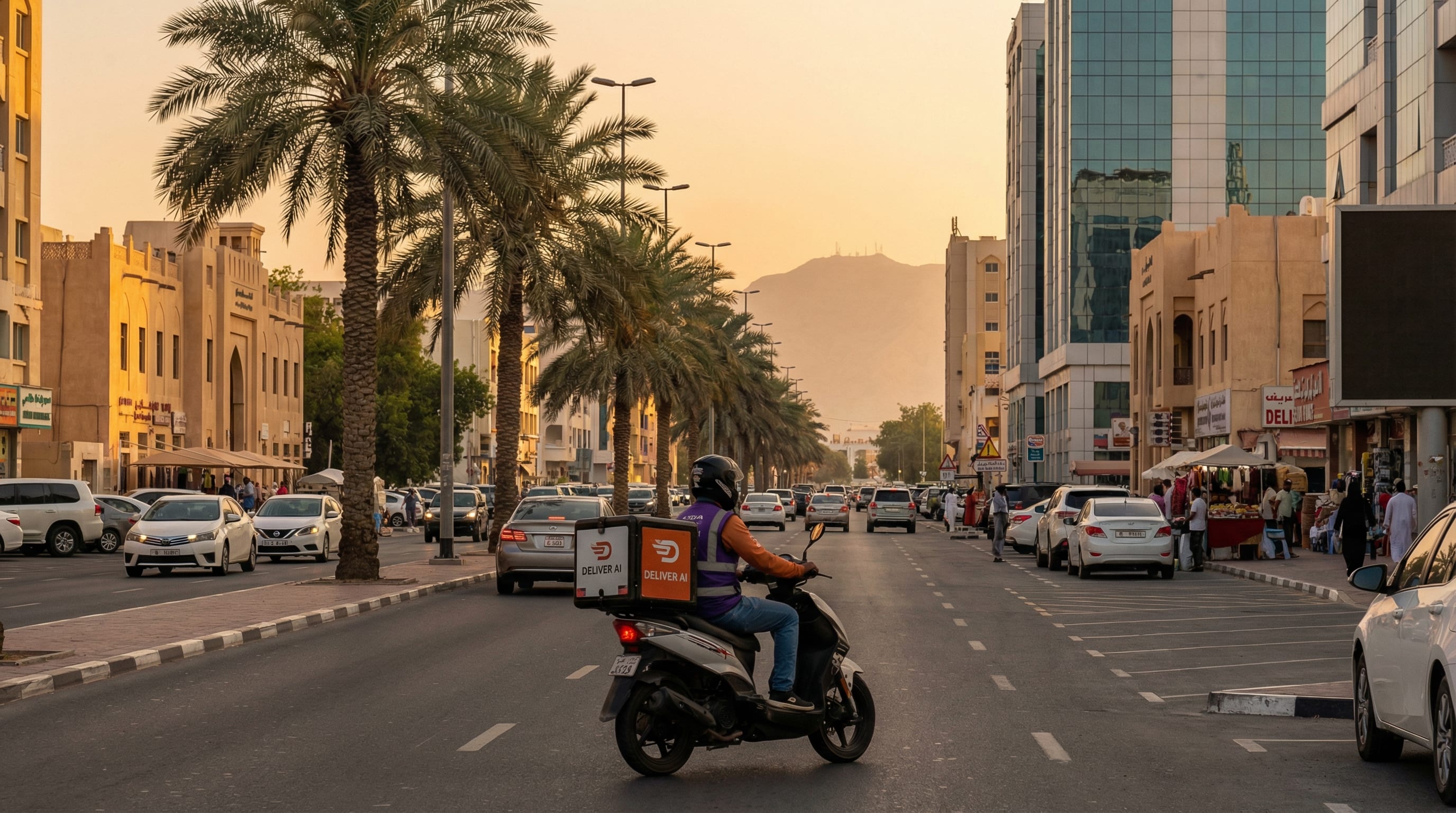
Same-Day Delivery in Al Ain: The Complete Guide to Courier Services, Providers & Pricing
From the Garden City’s oasis streets to your doorstep — how Al Ain’s delivery ecosystem is evolving with micro-fulfillment, the Onwani addressing system, and the $3 billion Hafeet Rail connection.
Table of Contents
Al Ain’s Delivery Landscape
Al Ain is the fourth-largest city in the United Arab Emirates and the second-largest in the Emirate of Abu Dhabi. Known as the Garden City for its lush oases and tree-lined boulevards, Al Ain sits approximately 150 kilometres inland from both Dubai and Abu Dhabi — a geographic position that has historically made it one of the more challenging cities for the country’s delivery infrastructure. Unlike the coastal hubs that benefit from proximity to ports, air cargo terminals, and dense urban warehouse clusters, Al Ain has long been dependent on cross-emirate trucking from warehouses in Dubai’s Jebel Ali or Abu Dhabi’s Khalifa Industrial Zone.
That picture is changing rapidly. The UAE logistics market is valued at an estimated $54.5 billion, with the nation’s e-commerce sector approaching AED 27 billion in annual transactions. As online shopping penetrates deeper into cities beyond Dubai and Abu Dhabi, Al Ain has become a strategically important node that delivery companies can no longer afford to underserve. Companies like iMile have established dedicated warehouses directly in Al Ain — including facilities in Wadi Al Ain 1 and Al Noud — enabling them to bypass the coastal-to-inland trucking model entirely. The city’s Onwani addressing rollout, now at 79% completion, is simultaneously eliminating one of the most persistent pain points in UAE last-mile delivery: imprecise addresses.
Looking further ahead, the $3 billion Hafeet Rail project — connecting Abu Dhabi to Sohar Port in Oman via Al Ain — will fundamentally reshape cargo routing through the region, transforming Al Ain from a logistics endpoint into a transit corridor. For businesses, consumers, and courier companies alike, Al Ain’s delivery ecosystem is entering a new chapter.
How Same-Day Delivery Works in Al Ain
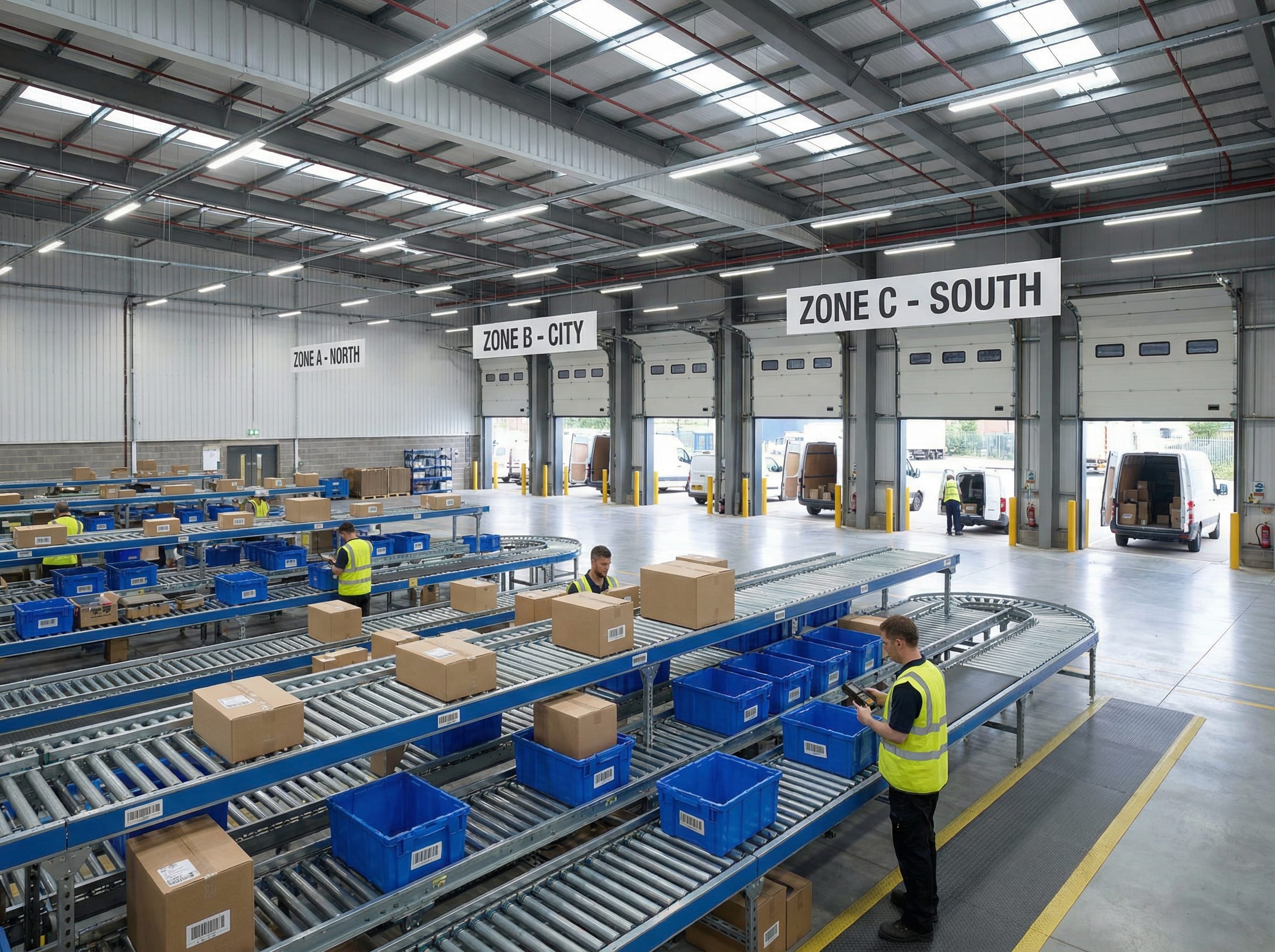
The mechanics of same-day delivery in Al Ain differ meaningfully from the process in coastal cities like Dubai. The primary variable is distance: most e-commerce inventory is still warehoused in Dubai or Abu Dhabi, meaning same-day orders must clear both a warehouse picking stage and a cross-emirate transit leg before reaching the local Al Ain hub for last-mile dispatch. Here is how the typical same-day delivery chain operates, step by step.
Top Courier Companies in Al Ain
The courier landscape in Al Ain is a mix of regional logistics giants, tech-first disruptors, national postal infrastructure, and local specialists. Each operator brings different strengths — from Aramex’s deep e-commerce fulfillment network to iMile’s dedicated Al Ain warehouse footprint. Understanding what each provider offers, and where they excel, is essential for businesses looking to optimise delivery performance in the Garden City.

Delivery Speed Tiers
Not every shipment to Al Ain demands same-day urgency. The market offers a range of speed tiers, each with different cost structures, cut-off windows, and provider options. Understanding these tiers allows businesses to match their delivery promise to customer expectations without overspending on unnecessary speed. The table below summarises the four primary delivery speed tiers currently available for Al Ain shipments.
| Speed Tier | Estimated Cost (AED) | Cut-Off Time | Typical Providers |
|---|---|---|---|
| Economy (2–6 days) | AED 9.89–25 | No cut-off | Parcelex, standard e-commerce shipping, Emirates Post economy |
| Next-Day | AED 20–30 | After midday | Most carriers (Aramex, iMile, DHL domestic), default for many e-commerce platforms |
| Same-Day | AED 35–50 | 12:00 PM–1:00 PM | Swftbox (12 PM cut-off), Ounass (1 PM), Al Arabia Delivery |
| Express 2-Hour | ~AED 50+ | Morning only | Limited in Al Ain — mostly Dubai-centric; requires local micro-fulfillment centres |
The economics are clear: same-day delivery in Al Ain commands a 40–80% premium over next-day, and express 2-hour service — where available — can cost more than double the same-day rate. For most e-commerce operations, next-day delivery represents the best balance of speed and cost. Same-day should be reserved for high-margin products, perishables, or where the competitive advantage of speed directly drives conversion rates.
It’s worth noting that the express 2-hour tier remains largely aspirational for Al Ain. Without a critical mass of local micro-fulfillment centres storing inventory within the city, true 2-hour delivery is only feasible for merchants who already maintain Al Ain stock — primarily grocery chains and food delivery platforms with dark store infrastructure.
Pricing & Cost Comparison
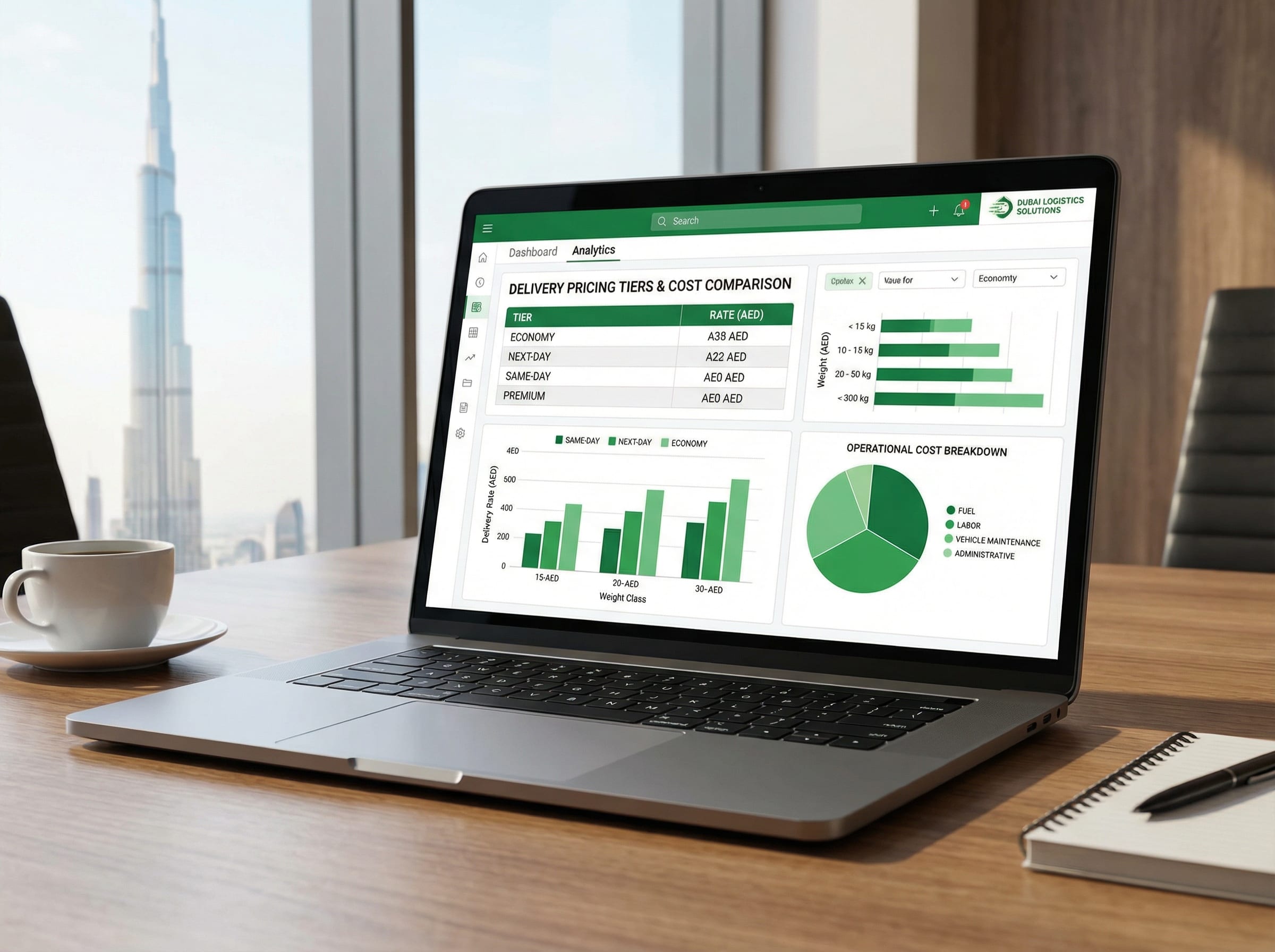
Delivery pricing to Al Ain is not a single number — it varies significantly depending on the service model, speed tier, parcel weight, and whether cash-on-delivery is involved. Understanding the pricing landscape is critical for both individual consumers comparing options and businesses modelling their delivery cost structure. Below are the four primary pricing models currently operating in the Al Ain delivery market.
Geographic Pricing: Cross-Border Rates
For international shipments into Al Ain, cost structures differ significantly. Express courier delivery from India to Al Ain, for example, runs approximately ¥800/kg (~AED 35/kg) via express air freight, while economy sea-air routes come in around ¥375/kg (~AED 16.5/kg). These rates reflect the premium associated with inland delivery compared to port-adjacent cities.
In-House vs. Outsourced Delivery
Some Al Ain businesses consider running their own delivery fleet. While this offers maximum control, the cost comparison typically favours outsourcing: a single dedicated delivery driver costs AED 5,000–8,000/month in salary alone, before vehicle lease, fuel, insurance, and maintenance. For businesses shipping fewer than 30–40 parcels per day, outsourcing to a 3PL or aggregator is almost always more cost-effective.
Coverage Zones in Al Ain
Delivery coverage in Al Ain is not uniform. The city’s sprawling, low-density urban layout means that courier companies must make deliberate decisions about which zones to serve with same-day reliability and which areas default to next-day or multi-day windows. Understanding coverage geography is essential for businesses setting accurate delivery expectations on their storefronts.
- Central District — Al Ain’s commercial core with highest drop density and full same-day coverage from all major carriers
- Al Jimi — Major residential area, well-served by Aramex, iMile, and Swftbox with reliable same-day windows
- Al Muwaiji — Growing residential zone with expanding coverage; most carriers offer next-day as standard, same-day via premium tiers
- Al Hili — Established residential and commercial area near the Oman border; same-day available from most major providers
- Al Noud — Industrial and residential mix; iMile’s local warehouse proximity makes this zone particularly well-served
- Ain Al Faydah — Resort and residential area south of the city centre; same-day coverage from select carriers
- Al Bateen — Residential zone with good road connectivity; covered by most major courier networks
- Remote agricultural outposts — Farms and smallholdings on the city periphery; typically next-day or 2-day delivery due to low route density
- Deep desert communities — Settlements beyond the main urban footprint; limited carrier coverage, often requiring customer collection points
- Al Dhafra region border areas — Western periphery approaching Al Dhafra; most carriers classify this as outside standard Al Ain coverage
- Mountain-adjacent areas — Communities near Jebel Hafeet; accessible but with longer delivery windows due to routing complexity
- New development zones — Emerging residential projects on the outskirts; coverage varies as carriers update their route maps incrementally
For businesses targeting Al Ain customers, the practical implication is clear: same-day delivery promises should be limited to the core urban zones listed in the left column. Offering blanket same-day guarantees across all Al Ain postcodes will inevitably lead to failed delivery promises in peripheral areas, eroding customer trust. The better approach is to validate the customer’s Onwani address against the carrier’s coverage API at checkout and display an accurate delivery estimate for their specific location.
The Onwani Addressing Revolution
If there is a single infrastructure development that has done more to improve delivery success rates in Al Ain than any other, it is the Onwani (“My Address”) system. Developed and rolled out by Abu Dhabi’s Department of Municipalities and Transport (DMT), Onwani represents a fundamental shift in how addresses work across the emirate — and its impact on courier operations is profound.
For decades, UAE addressing relied on PO Boxes for mail and descriptive, informal directions for physical delivery: “Villa 4, behind the large mosque, near the roundabout with the coffee pot statue”. In a city like Al Ain — with its sprawling villa compounds, similar-looking residential streets, and limited street naming — this system was a persistent source of delivery failures.
Drivers spent an average of 10–15 additional minutes per delivery making phone calls to customers for directions, navigating unmarked streets, and circling gated compounds looking for the correct entrance. Failed first-attempt deliveries were common, driving up costs and eroding customer satisfaction. For e-commerce businesses, each failed delivery attempt costs an estimated AED 15–25 in wasted driver time, fuel, and re-scheduling overhead.
The Onwani system assigns a unique standardised address to every building in Abu Dhabi emirate, following the format: Building Number + Street Name + City + Area. Physical QR codes on street signs are backed by a comprehensive GIS (Geographic Information System) database, enabling precise GPS coordinate lookup for any Onwani address.
As of late 2024, the Onwani rollout in Al Ain has reached 79% completion — meaning nearly four out of five buildings in the city now have a standardised, machine-readable address. Couriers can scan QR codes via the Onwani app or resolve addresses directly through Google Maps integration, navigating to the exact building without a single phone call to the customer.
The impact on delivery operations is measurable: carriers report a 20–35% reduction in failed first-attempt deliveries in Onwani-covered zones, along with significant decreases in average delivery time per drop. For businesses, integrating Onwani address validation into their checkout flow is quickly becoming a competitive necessity rather than a nice-to-have feature.
Food & Grocery Delivery in Al Ain
Food and grocery delivery represents the most time-sensitive segment of Al Ain’s delivery ecosystem. While parcel delivery operates on same-day and next-day windows, food delivery demands fulfillment in 20–45 minutes — a fundamentally different operational model that requires local inventory, dark store infrastructure, and dense rider networks. Al Ain’s food delivery market has grown rapidly, with several major platforms now maintaining active operations in the city.
Last-Mile Challenges
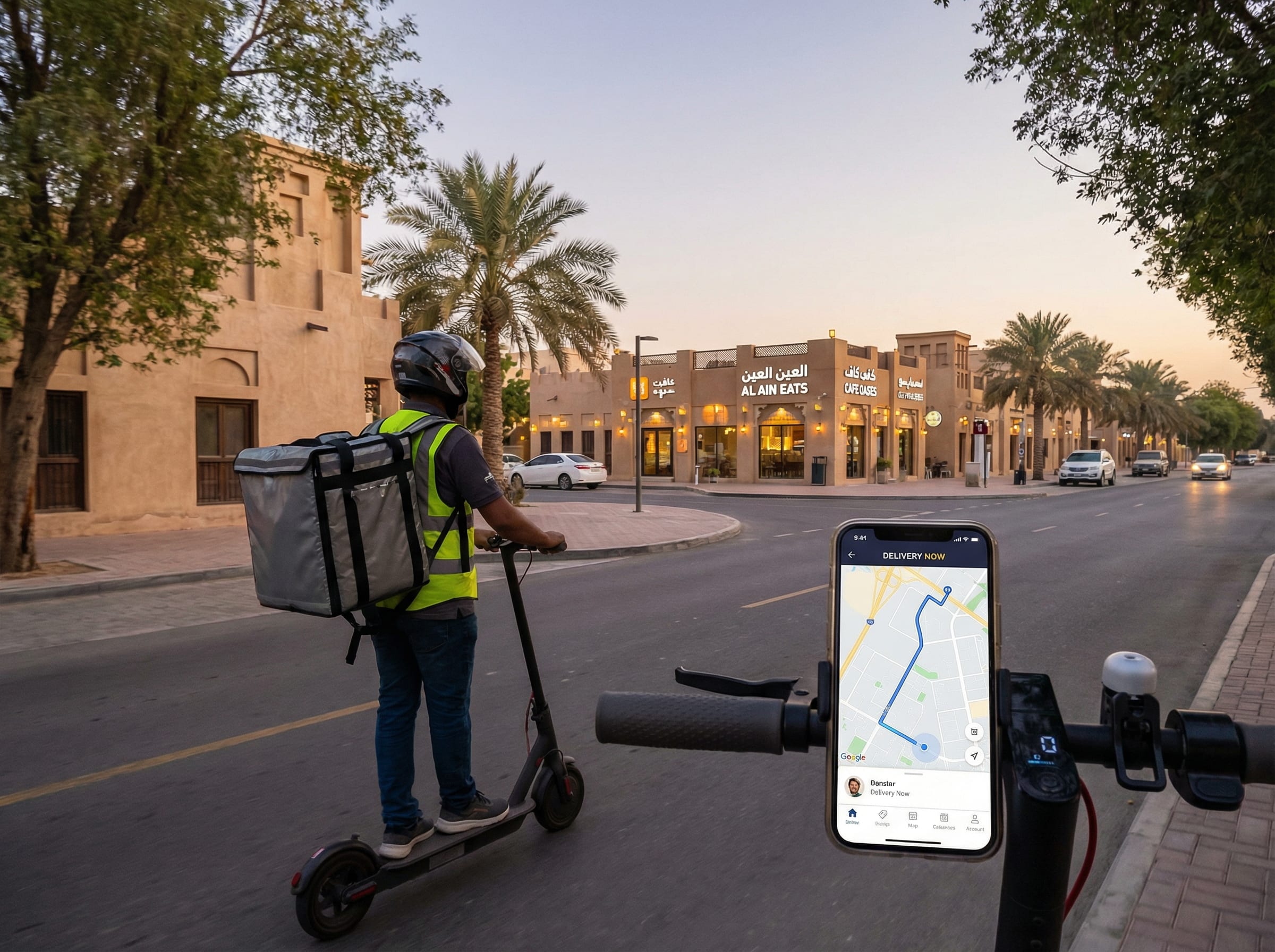
Al Ain’s delivery ecosystem faces a distinct set of challenges that differ from those in Dubai or Abu Dhabi. Understanding these challenges is not merely academic — it directly informs the logistics strategy that businesses should adopt when serving Al Ain customers. The last mile, globally, accounts for nearly 50% of total transportation costs in delivery operations. In Al Ain, several local factors amplify this cost further.
Business Optimization Tips
Delivering to Al Ain profitably requires more than simply partnering with a courier and hoping for the best. The businesses that perform best in this market are those that take a structured approach to logistics optimisation — from warehouse positioning and carrier selection to customer communication and address validation. The following six strategies represent the highest-impact actions available to businesses serving Al Ain customers today.
Frequently Asked Questions
Final Takeaway
Same-day delivery in Al Ain is no longer aspirational — it is operational, growing, and becoming increasingly competitive. The combination of dedicated local warehousing (iMile, Clarion), the Onwani addressing revolution (79% complete), tech-first carrier platforms (Swftbox, Parcelex), and the forthcoming Hafeet Rail corridor is transforming a city that was historically underserved by UAE logistics into a market that commands serious investment.
For businesses, the playbook is clear: match your delivery promise to what the infrastructure can actually support, invest in Onwani integration, leverage aggregators for cost efficiency, and position inventory locally where volumes justify it. For consumers, the range of delivery options in Al Ain — from AED 9.89 economy to AED 50 express — is broader and more reliable than at any point in the city’s history.
The next inflection point will come when the Hafeet Rail project reaches operational status, turning Al Ain into a genuine logistics corridor rather than a terminal delivery point. Businesses that build strong delivery infrastructure now will be best positioned to capitalise on that transformation.
Sources & References
- iMile Delivery UAE — imile.com. Al Ain warehouse operations (Wadi Al Ain 1, Al Noud); 99.5% on-time delivery rate; AI-powered route optimisation documentation.
- Swftbox UAE — swftbox.com. 12:00 PM same-day cut-off for Al Ain; delivery by 10 PM guarantee; Shopify and WooCommerce integration capabilities.
- Ounass — ounass.ae. Same-day delivery to Al Ain with 1:00 PM cut-off; AED 35 same-day fee; AED 25 COD surcharge documentation.
- Parcelex — parcelex.com. Aggregator platform with rates from AED 9.89; multi-carrier comparison for Al Ain delivery routes.
- Yalla Courier — yallacourier.com. Courier aggregation platform; bulk shipping discounts; carrier rate comparison for UAE domestic and Al Ain-specific routes.
- Abu Dhabi Department of Municipalities and Transport (DMT) — dmt.gov.ae. Onwani addressing system specifications; 79% completion rate in Al Ain as of late 2024; GIS and spatial API documentation.
- Aramex — aramex.com. UAE e-commerce fulfillment network coverage; Al Ain last-mile delivery operations; COD collection and reverse logistics infrastructure.
- Emirates Post — emiratespost.ae. National postal network coverage; Al Ain PO Box infrastructure; domestic delivery rate schedules.
- NAKHL Cargo — nakhlcargo.com. Dubai-to-Al Ain same-day and next-day freight services; bulk cargo options for business shipments.
- Al Arabia Delivery Services — alarabiadelivery.ae. Local Al Ain same-day and instant delivery offerings; food, furniture, and document courier services.
- Talabat — talabat.com. Al Ain restaurant and grocery delivery coverage; Talabat Mart (tMart) dark store operations and 20-minute delivery capability.
- Noon Food — noon.com. Food delivery operations in Al Ain covering Central District, Al Hili, Al Muwaiji, and Ain Al Faydah zones.
- Careem — careem.com. “Everything App” food and grocery delivery expansion into Al Ain; ride-hailing to delivery infrastructure leverage.
- MAF Carrefour — carrefouruae.com. Al Ain scheduled grocery delivery with cold-chain capabilities; click-and-collect service documentation.
- UAE Logistics Market Report — Multiple sources (Mordor Intelligence, Research and Markets). UAE logistics market valued at approximately $54.5 billion; growth drivers and e-commerce penetration data.
- UAE E-Commerce Sector — Multiple sources (Dubai Chamber, Statista). E-commerce sector approaching AED 27 billion in annual transactions; inland city penetration trends.
- Hafeet Rail Project — Etihad Rail / National Railways. $3 billion Abu Dhabi–Al Ain–Sohar Port railway; cargo capacity projections and construction timeline.
- Clarion Shipping & Logistics — clarionshipping.com. Al Ain 3PL warehousing and fulfillment services; inland warehousing model documentation.
- Last-Mile Delivery Cost Analysis — McKinsey & Company, Capgemini Research Institute. Last-mile accounting for ~50% of total transportation costs; failed delivery cost estimates (AED 15–25 per attempt).
- UAE Climate Data — National Centre of Meteorology. Al Ain summer temperature ranges (45°C+); heat impact on outdoor operations and cold-chain logistics.
Let's talk scale.
Whether you're looking to optimize delivery, centralize operations, or unlock new revenue — Axiom X is your growth partner.
Our Headquarters
UAE