
Logistics and Supply Chain Management in Dubai: The Definitive Guide
How a 45-minute customs-bonded corridor, $54 billion in logistics infrastructure, and an AI-blockchain digital layer turned Dubai into the world's supply chain super-connector.
In This Guide
- How Dubai Became the World's SCM Hub
- The Sea-Land-Air Corridor
- Dubai's Logistics Market by the Numbers
- The Red Sea Crisis — How Dubai Adapted
- The Digital Revolution — AI & Blockchain
- Top 5 SCM Challenges in Dubai
- Government Initiatives Powering the Ecosystem
- Etihad Rail — The Fourth Pillar
- SCM Best Practices — Do's and Don'ts
- FAQ, How to Choose & Sources
How Dubai Became the World's Supply Chain Hub
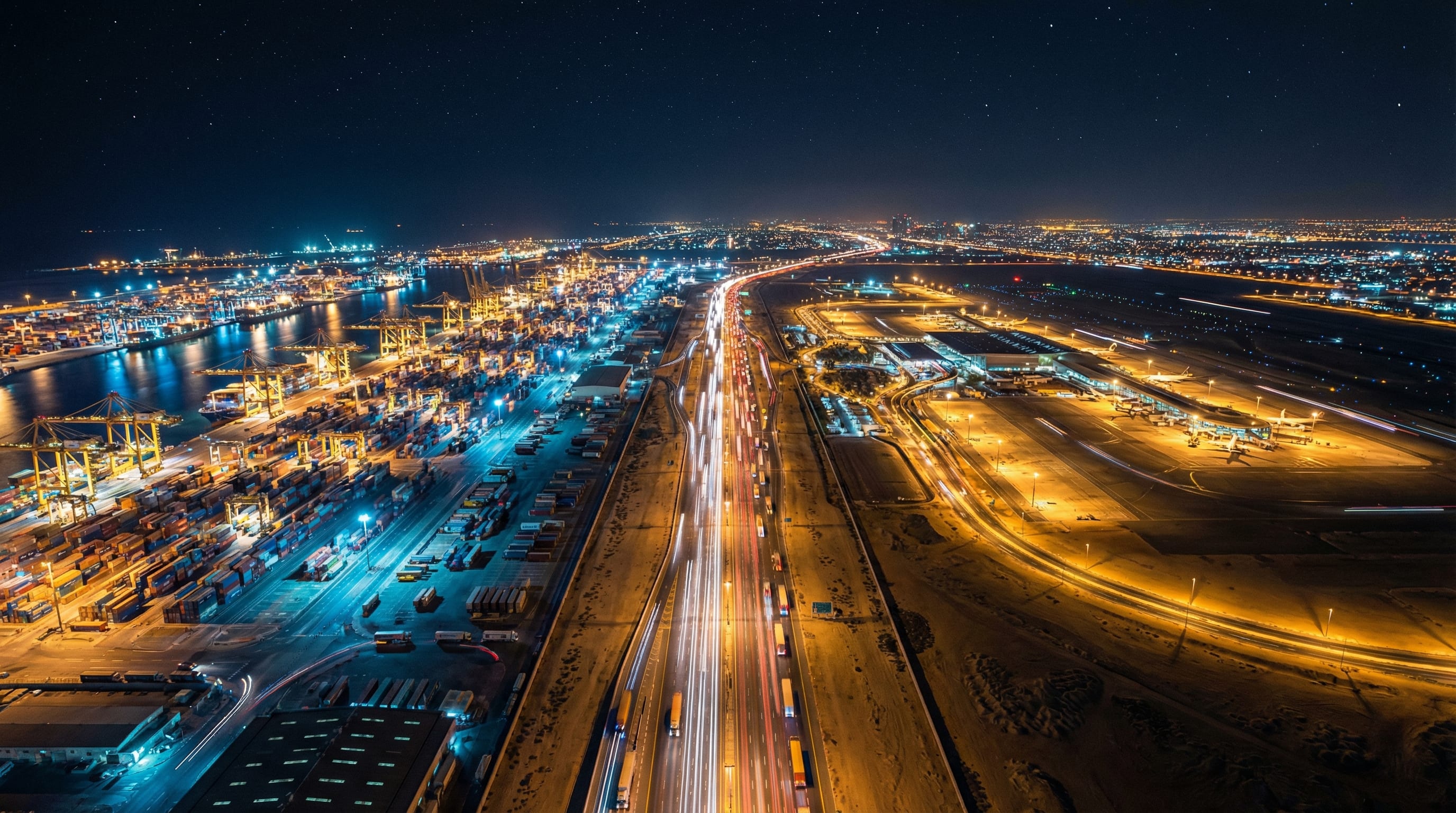
Forty years ago, Jebel Ali Free Zone Authority — JAFZA — opened its gates to just nineteen companies on a stretch of desert coastline southwest of Dubai. Today, 11,472 companies from 145 countries operate within its borders, and the corridor between that free zone and the port it anchors handles more containerized cargo than any other single logistics district in the world outside East Asia. The transformation is not accidental. It is the product of four decades of deliberate policy, relentless infrastructure investment, and a governance model that treats logistics not as an economic sector but as the foundational layer on which every other sector depends.
Understanding how logistics and supply chain management in Dubai reached this scale requires tracing the milestones that converted a mid-sized Gulf trading post into the world's supply chain super-connector. Each decade brought a structural shift — not just larger facilities, but entirely new capabilities that opened previously inaccessible trade corridors.
The Jebel Ali Free Zone Authority is established with 19 pioneer companies operating under a bold experiment: 100% foreign ownership, zero import duties, and no restrictions on capital repatriation. The adjacent Jebel Ali Port, then barely five years old, provides the physical gateway. The combination of port access and free zone incentives proves immediately attractive, and the waiting list for zone allocation grows within the first eighteen months.
Dubai Ports Authority and Port Rashid Authority merge to form DP World, immediately creating one of the world's top five port operators. The restructuring brings institutional capital, global operational standards, and a strategic acquisition agenda. Over the following two decades, DP World expands to 78 marine terminals across 40 countries, turning Jebel Ali into the operational and commercial center of a global port empire — with all the cargo intelligence and network connectivity that implies.
The Dubai Logistics Corridor formally connects Jebel Ali Port, JAFZA, and Dubai World Central (now Al Maktoum International Airport) under a single customs bond. For the first time, cargo arriving by sea can be transferred to an aircraft without clearing customs twice, without re-inspection, and within a 45-minute transit window. This single policy innovation — the customs bond corridor — enables a class of logistics operations that physically cannot exist anywhere else in the world at equivalent scale.
In preparation for hosting Expo 2020, Dubai embarks on one of the most ambitious logistics infrastructure programmes in its history. The AED 128 billion Al Maktoum International Airport expansion is greenlit. New highway linkages between Dubai South, JAFZA, and central Dubai are fast-tracked. Grade A warehouse supply surges. When the Expo opens in October 2021 — delayed by one year due to the pandemic — the infrastructure it required remains permanently in service, materially expanding Dubai's logistics throughput capacity for the decade ahead.
The first commercial freight trains begin running on the Etihad Rail network, connecting Abu Dhabi industrial zones to Jebel Ali Port via a 75-kilometre spur. The full 1,200-kilometre national network, linking Oman through the UAE to Saudi Arabia, enters phased commercial service. For Dubai-based supply chain operators, rail provides a fourth mode — joining sea, air, and road — that reduces overland truck dependence to GCC markets by an estimated 40% for bulk and industrial cargo categories.
Dubai's logistics market reaches USD 54.6 billion in total throughput value. JAFZA alone hosts 11,472 companies from 145 nations, generating AED 353 billion in annual trade. Jebel Ali Port handles 15.5 million TEU per year, ranked fifth globally. Al Maktoum Airport processes 1.2 million tonnes of air freight annually, with expansion underway that will make it the world's largest aviation facility by the early 2030s. The D33 Economic Agenda targets positioning Dubai among the world's top five logistics hubs by 2033.
Each of these milestones shares a common characteristic: they do not merely scale existing capabilities. They create structural advantages that compound over time. The customs bond corridor could not exist without the port proximity. Etihad Rail's value multiplies because it connects to a port that is already a top-five global hub. The digital twin investments DP World is deploying in 2025-2026 build on sensor and data infrastructure that has been accumulating since the early 2010s. Dubai's supply chain management advantage is not a single feature — it is an ecosystem where each layer amplifies the others.
The Sea-Land-Air Corridor — How It Works
The Dubai Logistics Corridor is the single most operationally significant piece of supply chain infrastructure in the Middle East. Its defining feature — a customs bond that spans Jebel Ali Port, JAFZA, and Al Maktoum Airport — eliminates the most expensive friction in global logistics: customs duplication. Cargo does not need to clear customs on arrival by sea, clear again when entering the free zone, and clear a third time when boarding an aircraft. One bond covers the entire journey.
The result is a cycle time that fundamentally changes what is possible in multimodal routing. High-value electronics arriving from Shanghai by sea can be sorted, kitted with accessories, repackaged under a European brand, and loaded onto a flight to Frankfurt — all within a single business day, all under one customs declaration.
The operational implications extend well beyond raw transit time. Because the corridor operates under one bond, documentation complexity is dramatically reduced. Companies operating within JAFZA benefit from the same customs treatment whether their cargo departs by sea, air, or road — a flexibility that allows supply chains to switch modes dynamically based on urgency and cost without restructuring their customs compliance framework.
For supply chain management in Dubai, the corridor is not just infrastructure: it is a strategic platform. Companies that understand how to design their supply chains around the corridor's capabilities — using sea freight for bulk and standard goods while reserving air for high-value, time-sensitive shipments — consistently outperform competitors relying on single-mode routing from less connected markets.
Dubai's Logistics Market by the Numbers
The aggregate size of Dubai logistics as a market disguises the structural diversity within it. The USD 54.6 billion total encompasses six distinct segments, each with its own growth dynamics, competitive landscape, and infrastructure requirements. Understanding segment-level data — not just the headline figure — is essential for any operator evaluating where to position within the ecosystem.
The segment growth rates reveal where structural demand is accelerating fastest. E-commerce fulfilment at 20.4% CAGR and last-mile delivery at 18.7% CAGR are expanding at nearly three times the rate of the traditional freight transport segment — a reflection of the UAE's 62% online shopping penetration rate and the consumer expectation shift toward same-day and next-day delivery as a baseline standard rather than a premium service.
The warehousing shortage underpins everything. Grade A warehouse occupancy has reached 95% across prime Dubai logistics zones, with rental rates rising 18% year-on-year in 2024-2025. Developers have responded with 7 million square feet of new warehouse space currently under construction across Dubai South, JAFZA expansion zones, and the emerging Dubai Industrial City district — but much of this supply is already pre-committed to large-scale tenants. For supply chain operators in Dubai seeking Grade A space, early commitment and longer lease terms are increasingly non-negotiable.
The Red Sea Crisis — How Dubai Adapted
Beginning in late 2023 and accelerating through 2024, Houthi attacks on commercial shipping in the Red Sea triggered the most significant disruption to global trade routes since the Suez Canal blockage of 2021. For Dubai, a city whose logistics economy depends on the smooth flow of container traffic between Asia and Europe through the Suez Canal, the crisis represented an immediate stress test of every resilience claim the supply chain ecosystem had ever made.
Dubai passed. Not without pain — port congestion, air freight rate spikes, and inventory shortages were real — but the multimodal architecture of the Dubai Logistics Corridor provided contingency options that simply did not exist for logistics hubs with narrower capability profiles. The following comparison reflects conditions at peak disruption versus Dubai's operational response six months into the crisis.
- 7–15 day delays on Asia-Europe routes as vessels rerouted via Cape of Good Hope, adding 6,000–10,000 nautical miles per voyage
- Port bunching at Jebel Ali as rerouted vessels arrived in clusters, straining berth availability and dwell times increased 40%
- Air cargo rates spiked 180% as shippers converted sea-bound shipments to air freight to avoid delays, overwhelming Al Maktoum cargo capacity
- Fuel surcharges up 35% on all shipping lanes as vessel operating costs rose with longer route distances
- Inventory shortfalls for time-sensitive goods including pharmaceuticals, electronics, and fast fashion, with regional safety stock levels depleted
- Sea-to-air pivot via DLC — the customs bond corridor enabled rapid mode switching; Dubai became the sea-to-air conversion hub for time-sensitive Europe-bound cargo
- Overland routes via Saudi Arabia activated at scale — goods cleared Jebel Ali by sea, moved by bonded truck through Saudi Arabia, cleared customs at Riyadh or Jeddah for onward distribution
- Hafeet Rail — Oman bypass route — the Etihad Rail link to Oman allowed cargo destined for Muscat and Sohar Port to bypass Hormuz Strait risk entirely via inland rail
- Nearshoring & local manufacturing accelerated — Operation 300bn incentives attracted manufacturers to Dubai South and JAFZA, reducing import dependency for critical SKUs
- AI demand forecasting deployment increased 34% among Dubai-based 3PLs as operators sought to build safety stock models that could anticipate lane disruptions weeks in advance
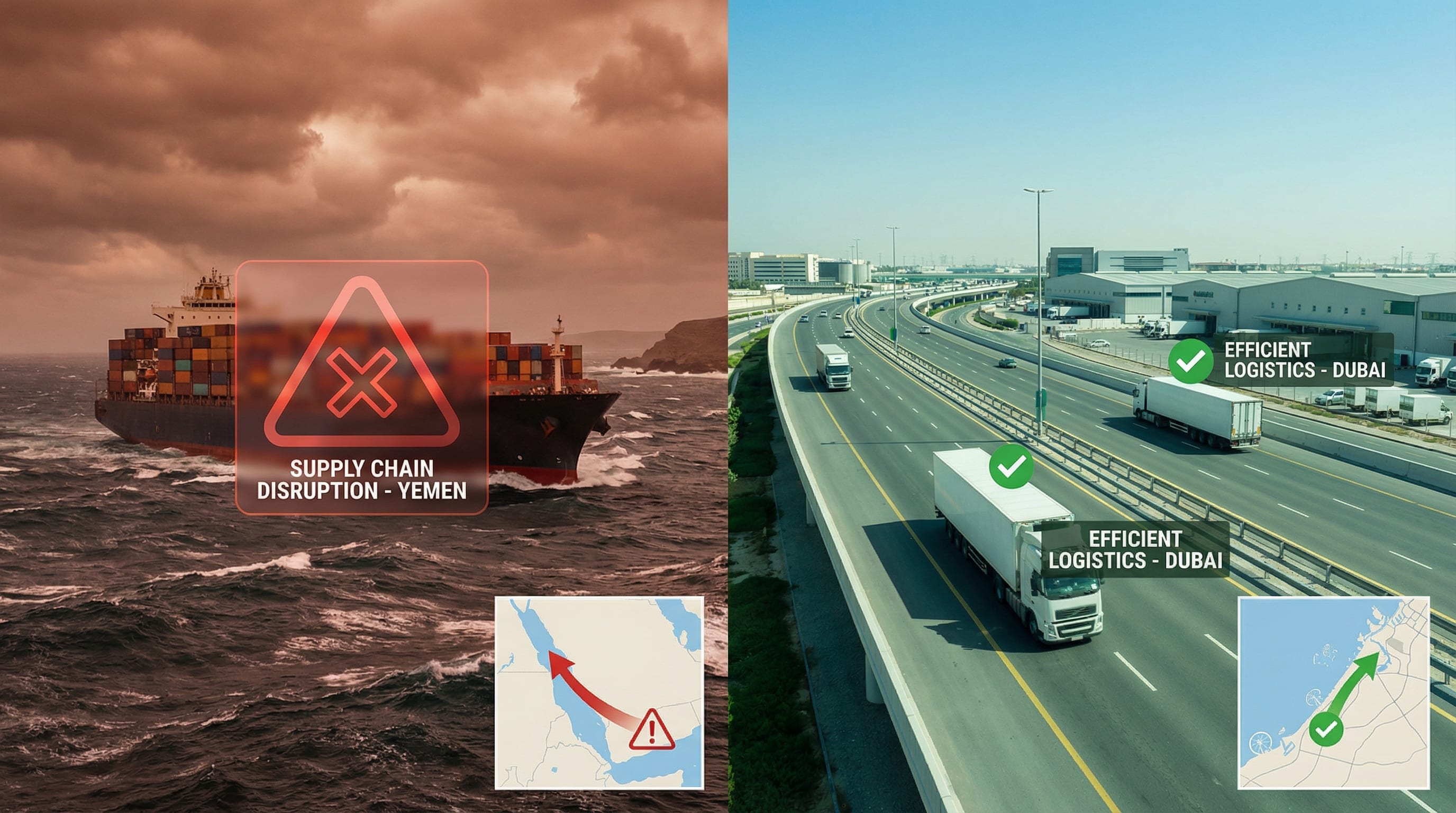
The Red Sea crisis delivered a counterintuitive commercial benefit to Dubai. As shippers globally scrambled to reroute cargo, Dubai's position as the only logistics hub in the region offering simultaneous sea, air, road, and rail multimodal switching under one customs regime became dramatically more valuable. Freight forwarding volumes through the Dubai Logistics Corridor increased 22% in H1 2024 compared to the same period in 2023. The crisis did not expose a weakness in Dubai supply chain infrastructure — it validated the investment thesis behind building it.
The Digital Revolution — AI, Blockchain & Digital Twins
Physical infrastructure explains how Dubai became a logistics hub. Digital infrastructure explains how it intends to remain one as global supply chains become increasingly data-driven. The UAE's National AI Strategy 2031 allocates significant resources to logistics as a priority sector, and both DP World and JAFZA have made multi-billion-dollar technology investments that are now visible in adoption metrics across the Dubai logistics ecosystem.
DP World's Chief Executive Sultan Ahmed bin Sulayem has described the company's AI investment as "the largest digital transformation in port history" — a program that encompasses computer vision-driven container tracking, machine learning-based berth scheduling, and predictive maintenance across Jebel Ali's 80+ quay cranes. The results are measurable: vessel turnaround times at Jebel Ali have decreased 23% since the AI scheduling system went live in 2023.

Blockchain adoption at 45% reflects an earlier-stage technology curve but significant momentum in specific verticals. Dubai Customs' Dubai Trade platform has integrated blockchain-based trade finance documentation since 2022, reducing letter of credit processing from 14 days to under 24 hours for participating banks and freight forwarders. The TradeLens ecosystem, though restructured globally, has successors in the form of DP World's proprietary CargoES platform and the UAE's cross-border blockchain initiative with Saudi Arabia.
Digital twin adoption at 35% is the metric to watch over the 2026-2028 period. Jebel Ali's full-port digital twin — currently in final integration testing — will enable real-time simulation of berth scheduling, container yard configuration, and quay crane allocation simultaneously. For supply chain management companies in Dubai, access to port digital twin data will enable a new class of inventory positioning strategies based on predictive port capacity rather than reactive responses to actual congestion.
Top 5 SCM Challenges in Dubai
No logistics ecosystem is without friction, and Dubai's rapid growth has created structural pressures that operators must navigate actively rather than assume the environment will resolve. The following five challenges represent the most common pain points reported by supply chain professionals operating in Dubai in 2025-2026, alongside the solution pathways that leading operators are deploying.
Grade A logistics space in prime Dubai zones has reached 95% occupancy. Rental rates rose 18% in 2024-2025. Operators face 6–12 month wait times for premium space in JAFZA and Dubai South. Speculative development has been insufficient to match demand growth driven by e-commerce expansion and nearshoring trends.
Seven million square feet of new Grade A warehouse space is under active construction across Dubai South Phase 2, JAFZA East, and Dubai Industrial City. Operators who cannot wait for new supply are leveraging shared 3PL models — partnering with established operators who hold excess capacity under long-term leases rather than securing standalone tenancies.
Dubai's logistics sector grew faster than its supply chain management talent pipeline. Demand for certified SCM professionals — particularly those with combined expertise in digital tools, customs compliance, and multimodal operations — exceeds supply by an estimated 35%. Mid-level operations managers with 5+ years of Dubai-specific experience command 40% salary premiums over equivalent roles in other markets.
Zayed University's SCM degree programme, CILT UAE's professional certification track, and the UAE Ministry of Economy's Emirati logistics talent pipeline are collectively increasing the qualified professional pool. Leading operators are supplementing formal credentials with in-house digital tool certification programmes, converting operationally experienced staff into technology-capable supervisors faster than external recruitment can achieve.
Last-mile delivery in Dubai costs AED 15–35 per consignment depending on zone, vehicle type, and delivery density. Failed first attempts — running at 22% industry average due to address imprecision and recipient unavailability — add AED 8–12 per re-attempt. The economics create a structural margin problem for operators serving high-volume, low-value e-commerce shipments.
The combination of dark store micro-fulfilment (reducing last-mile distances from 20+ km to 3–5 km), electric vehicle fleets (eliminating fuel variability), and AI-driven dynamic routing (reducing failed delivery rates by 31%) is restructuring last-mile economics. Leading operators have achieved sub-AED 18 cost-per-delivery in high-density zones using this three-component model.
UAE Securities and Commodities Authority mandated ESG reporting for listed companies from 2023, with extended requirements applying to significant unlisted operators from 2025. Logistics companies face carbon accounting obligations across Scope 1, 2, and 3 emissions. Multinational clients are inserting contractual sustainability clauses requiring verified emissions data as a condition of vendor qualification.
JAFZA has facilitated solar panel installation across warehouse rooftops, with 40% of existing Grade A warehouse stock now generating solar electricity. Blockchain-based carbon accounting platforms — including the UAE-developed Climate Action Data Trust — enable immutable, auditable emissions tracking across supply chains. Operators investing in solar and blockchain carbon ledgers are converting compliance costs into competitive differentiation with multinational clients.
The Red Sea crisis demonstrated that Dubai's position at the intersection of Asia-Africa-Europe trade routes creates exposure to geopolitical disruption. The Strait of Hormuz, through which 21% of global oil and 17% of global LNG passes, represents a second concentration risk. Single-lane dependence proved costly for operators without pre-established contingency routing.
The Dubai Logistics Corridor's multimodal architecture — sea, air, road, and rail under one bond — provides structural contingency that single-mode hubs cannot replicate. Operators who pre-negotiate rail capacity via Etihad Rail, maintain overland trucking relationships via Saudi Arabia, and hold standing air freight allocations at Al Maktoum can switch modes within 48 hours of a lane disruption without renegotiating from scratch.
Government Initiatives Powering the Ecosystem
Private sector investment and public infrastructure spending in Dubai's logistics sector operate within a policy framework that provides structural stability rare in emerging market logistics. Three government programmes, each with decade-long timelines and quantified targets, define the strategic environment within which logistics and supply chain management in Dubai will evolve through 2033.
The D33 Agenda commits AED 32 trillion in economic output and a doubling of Dubai's foreign trade volume over the decade to 2033. Logistics is designated a "foundation sector" — meaning investment in logistics infrastructure receives expedited approvals, enhanced free zone incentives, and priority access to government land allocations. For supply chain operators, D33 provides a 10-year policy stability horizon that makes long-term infrastructure investment decisions materially less risky. The agenda specifically targets attracting 100 multinational regional headquarters to Dubai by 2033, each of which will require integrated supply chain capabilities.
The UAE Logistics Strategy 2030 pairs market position targets with sustainability mandates that have direct operational implications for every company in the sector. The 30% emissions reduction target is not aspirational — it is backed by regulatory timelines, carbon accounting requirements, and financial incentives for early adopters. The strategy also mandates the digitisation of 80% of customs documentation by 2027, accelerating the transition to paperless trade that Dubai Customs has been building toward since the Mirsal 2 platform launch. For supply chain operators, the strategy's sustainability requirements are becoming vendor qualification criteria with major government-linked buyers.
Operation 300bn has already attracted AED 11 billion in industrial investment commitments to the UAE as of 2025, with major manufacturers establishing production facilities in KIZAD, Dubai South, and Khalifa Industrial Zone. For logistics and supply chain operators, this programme creates a structural shift in cargo origin: goods that were previously imported are increasingly manufactured domestically, reducing outbound sea freight dependency but creating new domestic distribution and inbound raw material supply chain requirements. The programme explicitly targets supply chain sovereignty in six strategic sectors: food, pharmaceuticals, electronics, metals, petrochemicals, and advanced textiles.
The convergence of these three programmes — trade volume growth, sustainability mandates, and industrial localisation — creates a compounding opportunity for well-positioned supply chain operators in Dubai. The operator who builds multimodal routing capability (meeting D33 trade growth demand), integrates blockchain carbon accounting (meeting Logistics Strategy 2030 sustainability requirements), and develops domestic distribution networks for locally manufactured goods (meeting Operation 300bn's localisation outcomes) is positioned to capture value from all three policy tailwinds simultaneously.
Etihad Rail — The Fourth Pillar
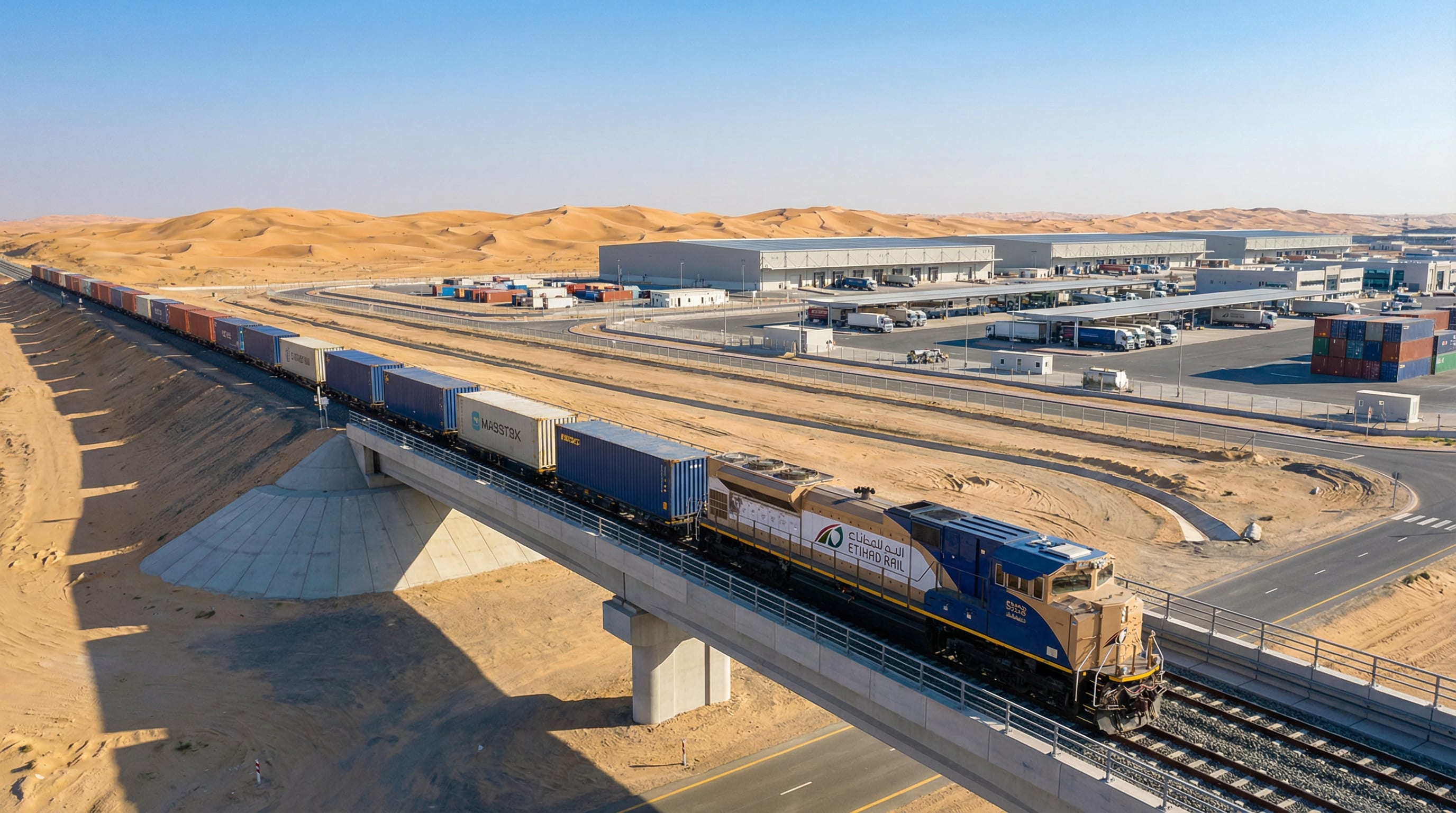
Sea, air, and road have defined Dubai logistics for four decades. Etihad Rail, the UAE's national freight rail network, adds a fourth mode that fundamentally changes the cost structure and risk profile of bulk and industrial supply chains serving the GCC. For operators who have historically relied on road freight for cross-border distribution, rail introduces a modal alternative that is 40-60% cheaper per tonne-kilometre for heavy cargo and largely immune to the fuel price volatility that has made road freight cost unpredictable since 2022.
The 75-kilometre Etihad Rail spur to Jebel Ali Port, connected to the full 1,200-kilometre UAE national network, began freight operations in 2023 and is scaling to full commercial capacity through 2025. For bulk, industrial, and heavy cargo categories bound for Abu Dhabi, Al Ain, Ruwais, and onward to Oman, rail reduces overland truck reliance by 40% and cuts per-tonne transport cost by up to 30%.
What Etihad Rail Means for Supply Chain Operators
The rail network's impact on supply chain management in Dubai extends beyond direct cost savings. Rail capacity at Jebel Ali effectively increases the port's throughput capacity without adding new berths or expanding the container yard — cargo moves off the port and into the inland network faster, reducing dwell times and freeing terminal capacity for the next vessel cycle. This systemic effect benefits all port users, not just those specifically using rail.
For the Etihad Rail route to Oman via the Hafeet Rail link, the strategic significance during the Red Sea crisis was significant: goods could transit from Jebel Ali Port through the UAE interior to Sohar Port in Oman, providing an alternative export gateway that bypasses the Strait of Hormuz risk entirely. As the GCC rail network continues to extend toward Saudi Arabia and Kuwait, the strategic optionality this provides to Dubai-based supply chain operators will increase substantially.
- 75 km — dedicated Etihad Rail spur connecting Jebel Ali Port to the national network
- 1,200 km — total UAE national freight network, with cross-border extensions to Oman and Saudi Arabia
- 2023 — commercial freight operations began on the Jebel Ali–Ruwais corridor
- 2025 — full commercial scaling with multiple daily freight services and expanded rolling stock
- 60% — lower carbon intensity per tonne-kilometre versus equivalent road freight
SCM Best Practices — The Do's and Don'ts
The most reliable map of what works and what fails in logistics and supply chain management in Dubai is not found in academic frameworks — it is found in the operational patterns of the companies that have built durable competitive positions here versus those that have struggled despite the market's structural advantages. The following do's and don'ts distil that accumulated experience into actionable guidance.
- Use multimodal routing. Design your supply chain from day one to utilise sea, air, road, and rail as switchable modes, not fixed commitments. The corridor makes mode switching operationally feasible — your contracts and carrier relationships should make it commercially feasible too.
- Integrate AI demand forecasting. Deploy machine learning-based demand models that incorporate port congestion data, weather patterns, and geopolitical risk signals. Companies using AI forecasting report 28% fewer stockout events and 19% lower safety stock costs in Dubai operations.
- Leverage free zone tax benefits aggressively. JAFZA, Dubai South, and DAFZA offer 0% corporate tax, 100% foreign ownership, and customs duty exemptions on goods that transit the zone. Structuring your value-add activities within the zone versus outside it can reduce landed cost by 8–15% on qualifying cargo.
- Diversify suppliers across regions. Maintain at least two qualified suppliers per critical component from different geographic regions. Red Sea disruption exposed single-region dependency as a structural vulnerability. Dual-sourcing adds 3–7% to procurement cost but removes tail-risk that can cost multiples more.
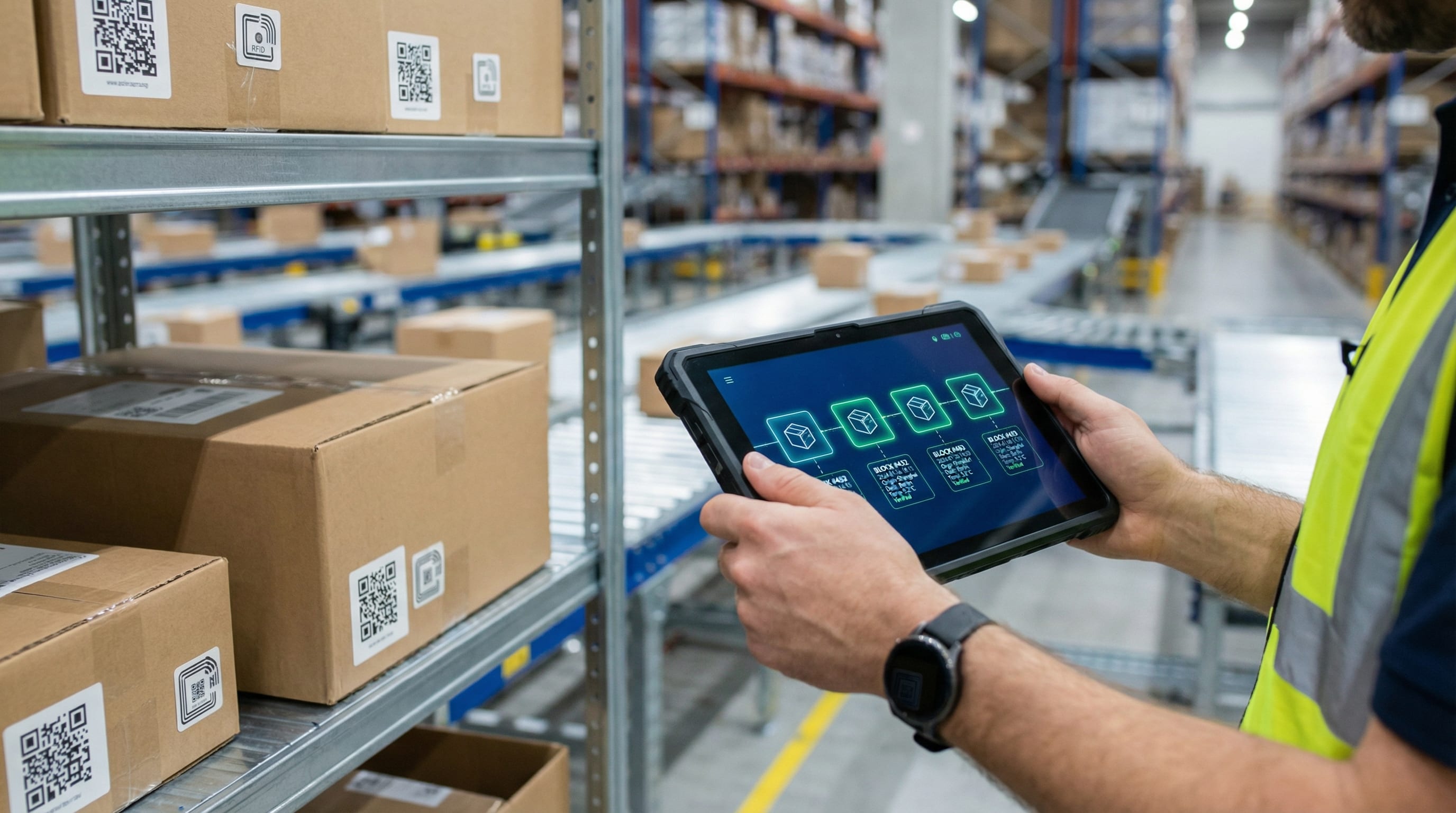
- Invest in blockchain provenance tracking. Particularly for pharmaceutical, food, luxury, and electronics categories where chain of custody verification is a regulatory or contractual requirement. Blockchain-verified provenance is becoming a vendor qualification criterion for major retailers and government buyers.
- Partner with established 3PLs for flexibility. Rather than locking 100% of your volume into owned infrastructure, maintain 3PL partnerships that provide variable capacity. In Dubai's 95%-occupied warehouse market, 3PL partnerships provide the buffer capacity that owned assets cannot.
- Don't rely on a single shipping lane. The Red Sea crisis demonstrated that 100% dependency on one routing corridor creates systemic risk. Even if your primary lane has operated without disruption for years, maintain contracted alternatives that can be activated within 48–72 hours.
- Don't ignore ESG compliance deadlines. The UAE Logistics Strategy 2030 emissions mandates and SCA ESG reporting requirements are not advisory. Operators who delay carbon accounting infrastructure will face mandatory compliance remediation costs that are significantly higher than proactive investment would have been.
- Don't underestimate last-mile complexity. Dubai's address system — GPS-coordinate-based rather than street-number-based — combined with resident unavailability patterns creates a 22% failed first-delivery rate industry average. Underinvesting in geocoding, delivery windows, and re-attempt logistics creates margin erosion that compounds at scale.
- Don't skip warehouse automation. In a market with 95% Grade A occupancy and 18% annual rental increases, warehouse automation is not a future investment — it is a present necessity. Operators who defer automation in favour of adding labour are making a cost structure decision that becomes progressively harder to reverse as rental and labour costs both rise.
- Don't hold excess inventory without digital twins. High holding costs in a high-rental market, combined with the speed at which demand patterns shift in Dubai's consumer and re-export economy, make intuition-based inventory positioning increasingly expensive. Digital twin models that simulate inventory positioning across demand scenarios save 12–18% in holding cost for operators who have implemented them.
Frequently Asked Questions
The following questions represent the most common queries from supply chain professionals, international businesses, and investors evaluating Dubai as a logistics base or supply chain hub.
Supply chain management in Dubai refers to the end-to-end coordination of goods movement, storage, transformation, and distribution through a market uniquely positioned at the intersection of three major trade corridors: Asia-Africa, Asia-Europe, and GCC intraregional trade. What makes Dubai different is the combination of physical infrastructure (the world's 5th busiest container port, the growing Al Maktoum cargo airport), free zone customs architecture (the 45-minute sea-to-air corridor under a single bond), and digital governance (98% electronic customs processing via Mirsal 2). No other market in the MENA-Africa-South Asia region offers equivalent multimodal capability under equivalent regulatory stability. The result is that supply chains routed through Dubai consistently achieve lower landed costs, faster transit times, and greater disruption resilience than equivalent chains routed through alternative regional hubs.
The Dubai Logistics Corridor sea-to-air transit operates at a minimum of 45 minutes under standard operating conditions. This means cargo discharged at Jebel Ali Port, transported by bonded truck through JAFZA to Al Maktoum Airport, and loaded onto a waiting aircraft can complete that journey in under one hour without clearing customs at any intermediate point. In practice, scheduled cargo transfers for high-priority shipments (pharmaceuticals, electronics, perishables) are pre-arranged to slot into aircraft loading schedules, with typical door-to-aircraft times of 2–4 hours for planned transfers and 6–12 hours for unplanned mode switches. The customs bond that makes this possible covers the entire 35-kilometre corridor under a single declaration, eliminating the intermediate inspection and documentation requirements that add 24–72 hours at competing hubs.
Logistics license costs in Dubai range from AED 15,000–25,000 annually for basic freight forwarding activities in Dubai South to AED 30,000–80,000+ for full-scope warehousing and distribution licenses in JAFZA. The best free zone depends on your specific activity profile: JAFZA is optimal for companies requiring direct port access, customs bonded warehousing, and sea-to-air corridor access — it is the most established zone with the deepest carrier and freight forwarder network. Dubai South is optimal for companies prioritising air cargo, last-mile e-commerce fulfilment, and proximity to the expanding Al Maktoum Airport. DAFZA (Dubai Airport Free Zone) is optimal for companies whose primary requirement is time-critical air freight in and out of Dubai International Airport. All three offer 100% foreign ownership, 0% corporate tax on qualifying activities, and no restrictions on capital repatriation. License setup typically takes 2–4 weeks across all three zones in 2025-2026.
Dubai handled the Red Sea supply chain disruption through active multimodal switching at a scale and speed not achievable from competing hubs. Cargo that could no longer transit the Red Sea cost-effectively was rerouted through four primary channels: (1) sea-to-air conversion via the Dubai Logistics Corridor for time-sensitive shipments, (2) overland bonded trucking through Saudi Arabia for GCC-destined cargo, (3) Etihad Rail to Sohar Port in Oman for Hormuz-bypass routing, and (4) increased nearshoring of critical categories to Dubai-based or UAE-based manufacturers supported by Operation 300bn incentives. Dubai Logistics Corridor freight volumes increased 22% in H1 2024 versus H1 2023, demonstrating that the disruption redirected trade through Dubai rather than away from it. For future resilience, the lesson is clear: operators who pre-establish agreements across multiple modes and carriers can convert geopolitical disruptions from crises into competitive advantages, capturing market share from operators without equivalent flexibility.
Dubai's supply chain technology ecosystem in 2025-2026 encompasses six primary technology layers: (1) IoT real-time tracking (82% adoption) — sensor-based container, vehicle, and inventory location tracking across the entire logistics chain; (2) AI route optimisation (78% adoption) — machine learning systems that dynamically adjust routing, scheduling, and carrier selection based on real-time congestion, weather, and demand data; (3) Predictive analytics (67% adoption) — demand forecasting models that anticipate inventory requirements 4–12 weeks ahead; (4) Blockchain provenance (45% adoption) — immutable chain-of-custody records for pharmaceutical, food, luxury, and regulated goods categories; (5) Digital twins (35% adoption) — virtual replicas of warehouses, port terminals, and supply chain networks enabling scenario simulation before physical decisions; (6) Autonomous vehicles and robotics (12% piloting) — automated guided vehicles in warehouses and autonomous trucks in bonded port zones, currently in structured pilots ahead of wider commercial deployment.
Choosing a supply chain partner in Dubai requires evaluating five criteria beyond standard price and capacity comparisons. 1. Multimodal capability: Does your partner have active carrier relationships across sea, air, road, and rail — or are they primarily a freight forwarder in one mode with subcontracted relationships in others? The difference matters acutely during disruptions. 2. Customs expertise: Can they manage JAFZA bonded operations, Mirsal 2 filings, AEO certification processes, and multi-jurisdiction customs documentation simultaneously? Customs errors in Dubai are expensive and timeline-destroying. 3. Technology integration: Can they provide real-time visibility into your cargo, generate ESG-compliant emissions data, and integrate with your ERP or WMS system via API? Manual reporting is a red flag in 2026. 4. Free zone positioning: Are they physically located within the relevant free zone, or do they subcontract zone-specific services? Physical presence in JAFZA or Dubai South is not the same as a partnership agreement with an operator who is. 5. Track record during disruption: How did they perform during the 2023–2024 Red Sea crisis? Partners who proactively switched modes and communicated clearly during that period are demonstrably more reliable than those who defaulted to delay notifications. Axiom X operates across all five criteria with direct JAFZA presence, full multimodal capability, and a documented Red Sea response record.
Ready to Optimise Your Dubai Supply Chain?
Axiom X provides end-to-end logistics and supply chain management services across the Dubai Logistics Corridor — JAFZA, Dubai South, and Al Maktoum Airport. Speak to our team for a tailored supply chain assessment.
Speak to Axiom XSources & References
- JAFZA — Jebel Ali Free Zone Authority Annual Report 2025. 11,472 companies, 145 countries, AED 353B annual trade.
- DP World — Jebel Ali Port Throughput Statistics 2025. 15.5 million TEU; vessel turnaround improvement data post-AI deployment.
- Dubai Customs — Mirsal 2 System Statistics 2025. 98% electronic processing rate; AEO certification programme data.
- UAE Ministry of Energy & Infrastructure — UAE National Logistics Strategy 2030. Emissions reduction targets; digital documentation mandates.
- Dubai Department of Economy & Tourism — D33 Economic Agenda, 2023. Trade doubling targets; top-5 logistics hub commitment.
- UAE Ministry of Industry & Advanced Technology — Operation 300bn Progress Report 2025. AED 11B attracted; six strategic sector targets.
- CBRE UAE — Dubai Industrial & Logistics Market Report Q1 2026. 95% Grade A occupancy; 18% rental increase; 7M sqft pipeline.
- Etihad Rail — Commercial Operations Update 2025. 75km Jebel Ali spur; 1,200km network; freight service scaling data.
- Mordor Intelligence — UAE Logistics Market Report 2025. $54.6B total market; segment CAGR projections.
- Dubai Future Foundation — AI in UAE Logistics Adoption Survey 2025. Technology adoption percentages; AI route optimisation ROI data.
- IATA — Dubai Air Freight Statistics 2025. Al Maktoum Airport cargo volumes; air freight rate movements during Red Sea disruption.
- Zayed University — Supply Chain Management Programme Data 2025. Talent gap statistics; salary premium data for certified SCM professionals.
- UAE Securities & Commodities Authority — ESG Reporting Mandatory Requirements 2025. Listed company mandates; extended scope to significant unlisted operators.
- Dubai Statistics Centre — Logistics Corridor Freight Volume Report 2024. 22% H1 2024 volume increase versus H1 2023 during Red Sea disruption period.
Let's talk scale.
Whether you're looking to optimize delivery, centralize operations, or unlock new revenue — Axiom X is your growth partner.
Our Headquarters
UAE