
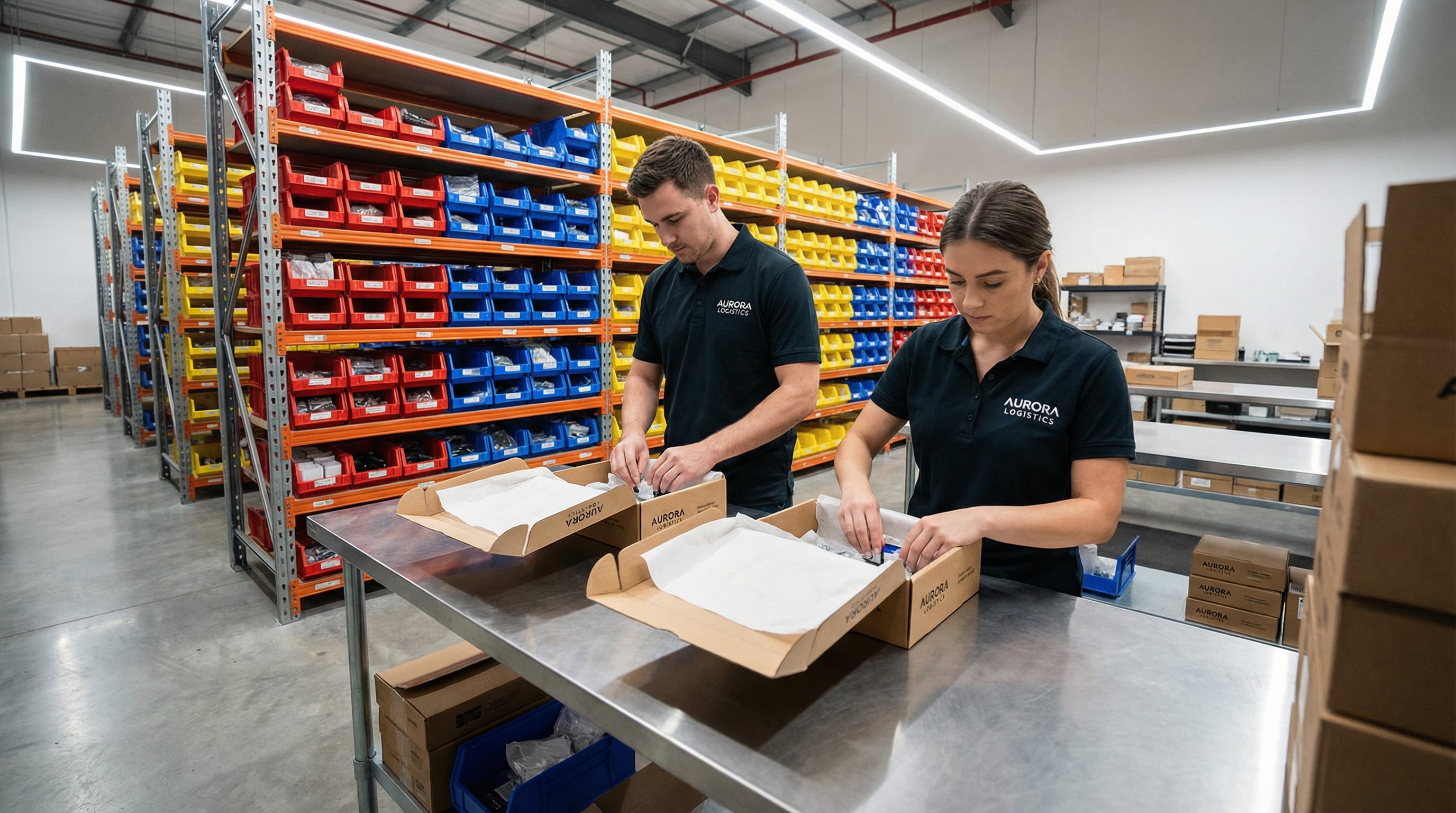
Kitting Services Explained: The Complete Guide for E-Commerce & Logistics
From product bundling and subscription boxes to manufacturing kits and retail-ready packaging — everything you need to know about kitting services, the 7-step process, ROI data, and how to choose a kitting partner in 2026.
In This Guide
What Is Kitting?
Kitting is the process of taking multiple separate products — each with its own unique SKU — and grouping them together into a single, ready-to-ship package sold under one new SKU. Instead of warehouse workers picking five individual items for every order, those items are pre-assembled into a “kit” that can be grabbed, scanned, and shipped as a single unit.
The term is often confused with related concepts. Bundling is a marketing and pricing strategy — selling two or more items together at a discount. Kitting is the physical warehouse operation that fulfils a bundle. Assembly involves physically joining components (screws, soldering, adhesives) to create a finished product. Kitting does not alter any individual item. Co-packing is a broader contract packaging service; kitting is one specific co-packing function.
Kitting can happen in two modes: batch kitting (pre-assembling hundreds or thousands of kits before sale) or on-demand kitting (assembling each kit when an order comes in). The right mode depends on demand predictability, storage costs, and how often kit contents change.
Kitting converts multi-pick orders into single-pick operations. A 5-item order that normally requires a picker to visit 5 locations becomes a single scan-and-ship action — cutting picking time by up to 40% and reducing assembly errors by 30–50%.
Market & Industry Data
The global kitting services market crossed the $10 billion mark in 2026, driven by e-commerce growth, subscription box proliferation, and rising carrier surcharges that make consolidated packaging a direct cost-saving strategy.
Shipping carriers raised rates by 5–7% in 2025, making kitting an even more compelling cost-reduction strategy against dimensional weight surcharges. Meanwhile, fulfilment costs now consume 25–35% of every order (8–12% of revenue) for e-commerce brands — making operational efficiency gains from kitting directly bottom-line impactful.
Types of Kitting
Kitting isn’t one-size-fits-all. The approach varies significantly depending on whether you’re building subscription boxes, preparing retail displays, or supplying manufacturing lines.
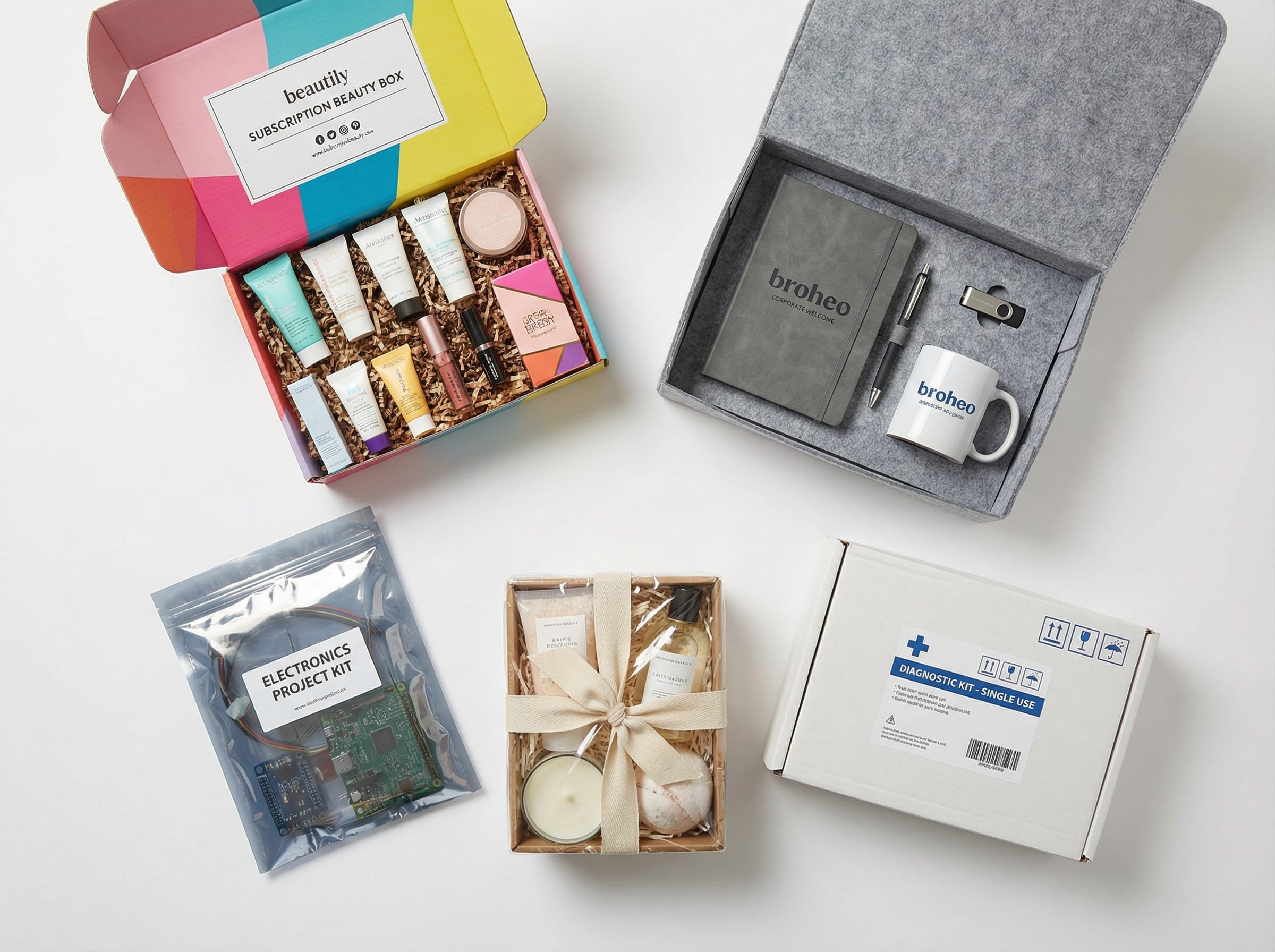
| Type | What It Is | Example | Key Requirement |
|---|---|---|---|
| Product Kitting | Combining related finished products into a new single SKU | Smartphone starter kit (phone + case + charger) | Consistent component quality |
| Subscription Box | Recurring assembly of curated products sent monthly/quarterly | Monthly beauty box with 4–5 curated samples | Personalisation, unboxing experience |
| Retail-Ready | Packaging for physical retail shelves with tags, barcodes, displays | Pre-loaded POP display for grocery end-cap | Retailer compliance, planogram specs |
| Manufacturing | Gathering raw materials/sub-assemblies for production lines | At-home medical diagnostic kit (swabs + vials + guide) | BOM accuracy, lot tracking |
| Promotional / Gift | Marketing materials, corporate swag, event giveaways | Influencer PR unboxing package for TikTok | Custom branding, seasonal flexibility |
| E-Commerce | Bundling complementary items to increase AOV and reduce shipping | “Buy 3 Get 1 Free” coffee variety pack | Right-sized boxes for DIM weight |
The 7-Step Kitting Process
Whether done manually or with automation, every kitting operation follows the same fundamental sequence. Here’s how a kit goes from individual components to a shipping-ready package.
Receive & Inventory Components
All individual items arrive at the warehouse, are scanned, inspected for damage, and logged into the inventory management system with lot codes and expiration dates where applicable.
Generate the Kitting Order
A work order is created specifying which components go into each kit, quantities needed, and any special instructions (tissue paper placement, insert orientation, shrink-wrapping).
Pick the Components
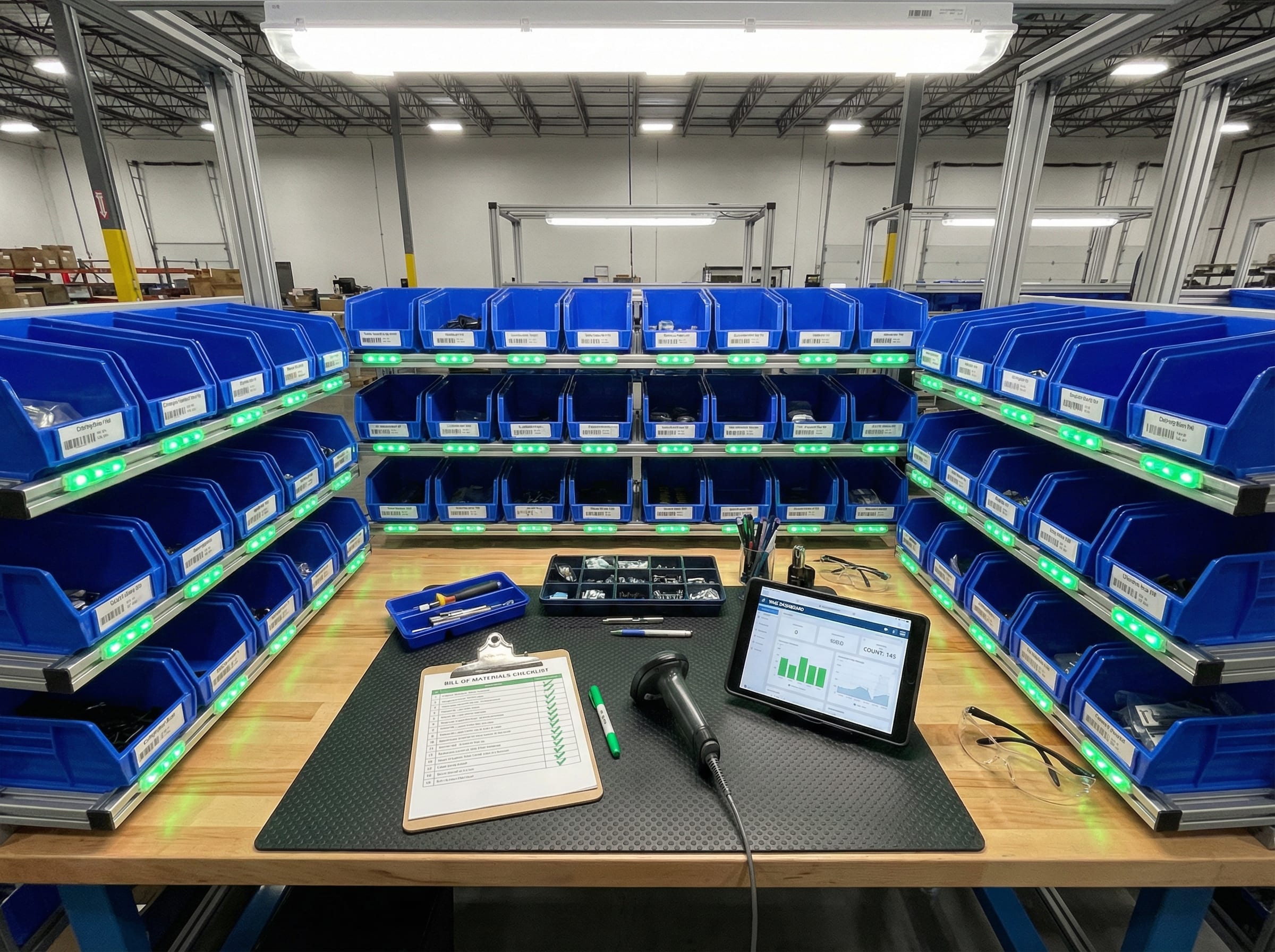
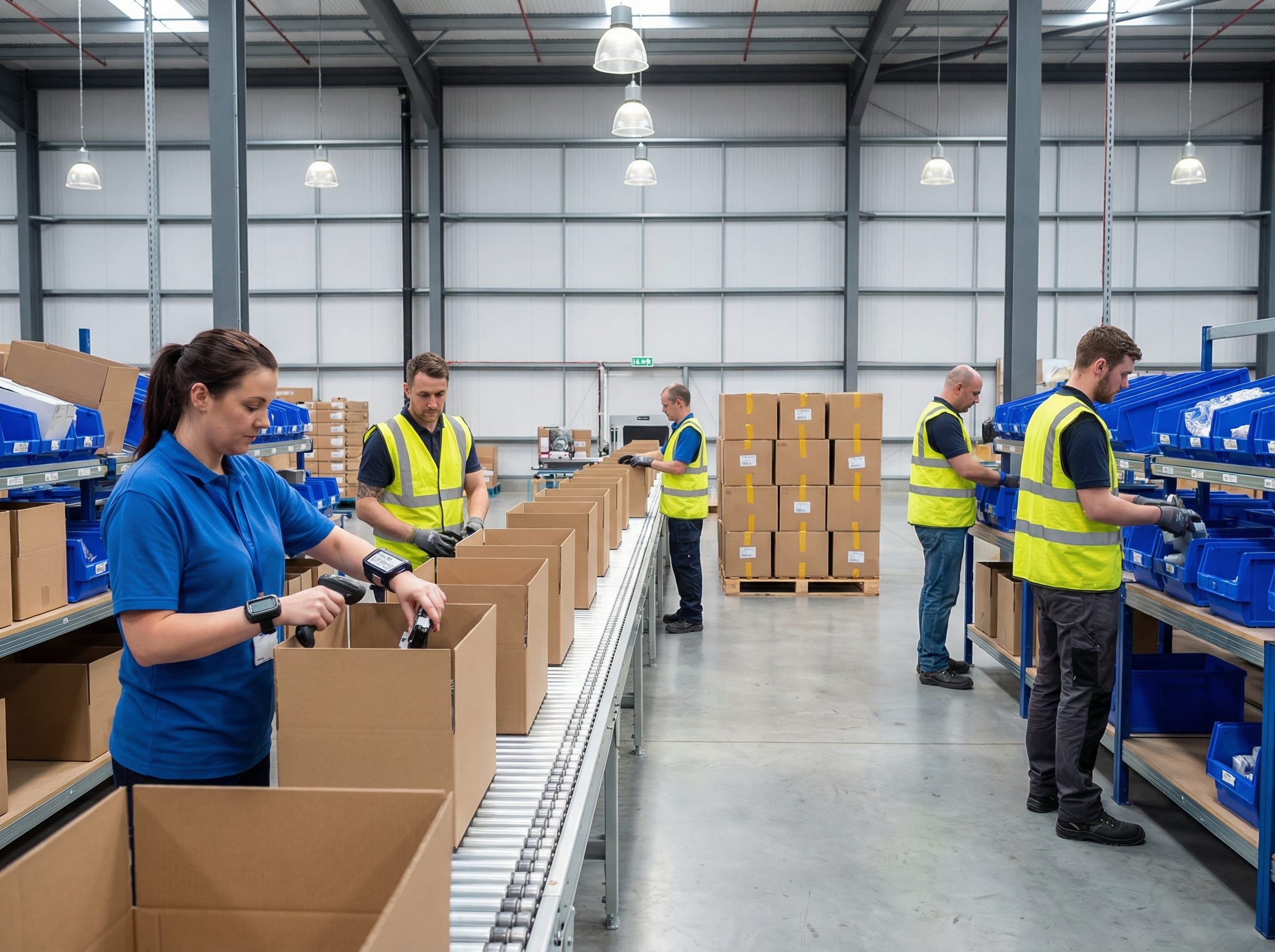
Workers pick bulk quantities of required SKUs from storage and bring them to a dedicated kitting station. In automated facilities, AMRs or Goods-to-Person systems deliver components directly.
Group & Package
Items are carefully arranged into designated packaging following strict presentation guidelines. This is where the unboxing experience happens — tissue paper, branded inserts, dunnage, and product positioning.
Assign New SKU & Label
The completed kit is sealed and a new barcode label applied representing the kit SKU. This single SKU replaces the multiple component SKUs in the inventory system.
Update Inventory System
The WMS automatically deducts individual component SKUs from available stock and adds the completed kit SKUs to finished goods inventory. This is the “SKU transformation” step.
Store & Fulfil Orders
Completed kits are stored in designated picking bins. When a customer orders the kit, a picker grabs one pre-packaged box and ships — a single-pick, single-scan operation.
Before & After: The ROI Case
The business case for kitting is built on hard data. Here’s what changes when a fulfilment operation transitions from individual-pick to pre-kitted workflows.
The ROI payback period for kitting implementation is typically 3–6 months. With automation layered on (cobots, pick-to-light systems), labour savings can reach 65%, and daily order output increases by 60%. For 3PLs, kitting services generate 20–35% higher profit margins compared to standard pick-and-pack operations.
Key Benefits at a Glance
Beyond the headline numbers, kitting delivers compounding benefits: simplified inventory management (fewer SKUs to track), improved customer experience (curated unboxing moments), reduced shrinkage (tighter handling controls), and higher average order values (bundled products encourage larger purchases). Inventory shrinkage across e-commerce doubled to 2.68% in 2025 — making kitting’s tighter handling controls more valuable than ever.
Outsourcing vs In-House
The decision to build kitting capability in-house or outsource to a 3PL depends on volume, complexity, and growth trajectory. Here’s how they compare.
Outsource to a 3PL
- Variable cost — pay per kit assembled ($1–$3/kit), no fixed overhead
- Elastic scaling for seasonal peaks (Ramadan, Black Friday, Eid)
- Leverage established WMS, barcode systems, and trained staff
- Bulk purchasing savings on packaging materials passed to you
- SLA-guaranteed accuracy rates (99%+ with photographic proof)
- Temperature-controlled facilities available in the UAE
Keep It In-House
- Full control over quality, branding, and presentation details
- No minimum order quantities — test 10 units immediately
- Faster iteration on kit contents without 3PL coordination
- Intellectual property stays within your facility
- Higher fixed costs: warehouse, staff, tech, materials
- Difficult to scale for seasonal spikes without temp labour
The 200-order threshold: Most fulfilment advisors recommend outsourcing once you exceed 200 orders per month, run seasonal promotions, or operate subscription boxes. Below that, in-house kitting is often more practical and cost-effective. For brands in between, a hybrid approach — core kitting in-house, peak overflow outsourced — provides the best of both worlds.
UAE Kitting Providers
Dubai’s free zones and fulfilment infrastructure make it a strong base for kitting operations. Here are six providers serving the UAE market with specialised kitting capabilities.

IQ Fulfillment
Robotics-assisted kitting with AI-driven processing. Temperature-controlled facilities. MENA pioneer in automated e-commerce fulfilment.
Automation LeaderTazeetPrep
Specialised in subscription boxes, promotional gift sets, and e-commerce kitting. Flexible MOQs for growing brands.
Subscription SpecialistHellmann Worldwide
Premium B2C fulfilment with custom branding options. E-commerce tax exemptions through free zone location.
Premium B2CClarion Shipping
E-commerce fulfilment plus 2-hour last-mile delivery. Temperature-controlled storage for cosmetics and supplements.
Fast Last-MileEshopify 3PL
Flexible kitting for SME e-commerce brands. Shopify and WooCommerce integration. Competitive rates for startups.
SME FriendlyHafro Logistics
Comprehensive VAS including kitting, labelling, QC, and real-time visibility. Sea freight access through Jebel Ali.
Full VAS SuiteThe Future of Kitting
Kitting is evolving from a manual warehouse task into an AI-powered, sustainability-driven, hyper-personalised operation. Four trends are reshaping the industry.
AI-Powered BOM Management
Bills of materials are becoming “living” digital twins managed via cloud MES platforms. AI continuously scans global supply chain data, predicts component shortages, and auto-suggests engineering-approved alternatives — eliminating stockouts that previously halted kitting lines.
Sustainable Packaging
The shift away from single-use plastics is accelerating. Mushroom-based mycelium, seaweed packaging, and water-soluble foams are entering kitting operations. Right-sizing algorithms calculate exact box dimensions to eliminate wasted cardboard — reducing both material costs and DIM weight surcharges.
On-Demand Kitting (Make-to-Order)
Instead of pre-assembling thousands of kits and paying for storage, operators are assembling kits on-the-fly when ordered. This reduces warehouse space needs, prevents dead stock from obsolete kit configurations, and enables real-time content changes.
“The future of kitting is personalisation at scale — millions of unique, one-of-a-kind kits assembled with the same speed and cost as mass production. AI-matched vitamin packs based on bloodwork. Makeup palettes selected by computer vision. Welcome kits tailored to each employee’s preferences.”
— Industry Trend Analysis, 2026The technology enablers — cobots, AR-guided pick-by-vision, and wearable Bluetooth ring scanners — are already mainstream. Pick-to-light systems alone increase kitting efficiency by over 40%, and AR glasses practically eliminate training time for new employees by projecting step-by-step assembly instructions directly into the worker’s field of view.
Frequently Asked Questions
Let's talk scale.
Whether you're looking to optimize delivery, centralize operations, or unlock new revenue — Axiom X is your growth partner.
Our Headquarters
UAE