
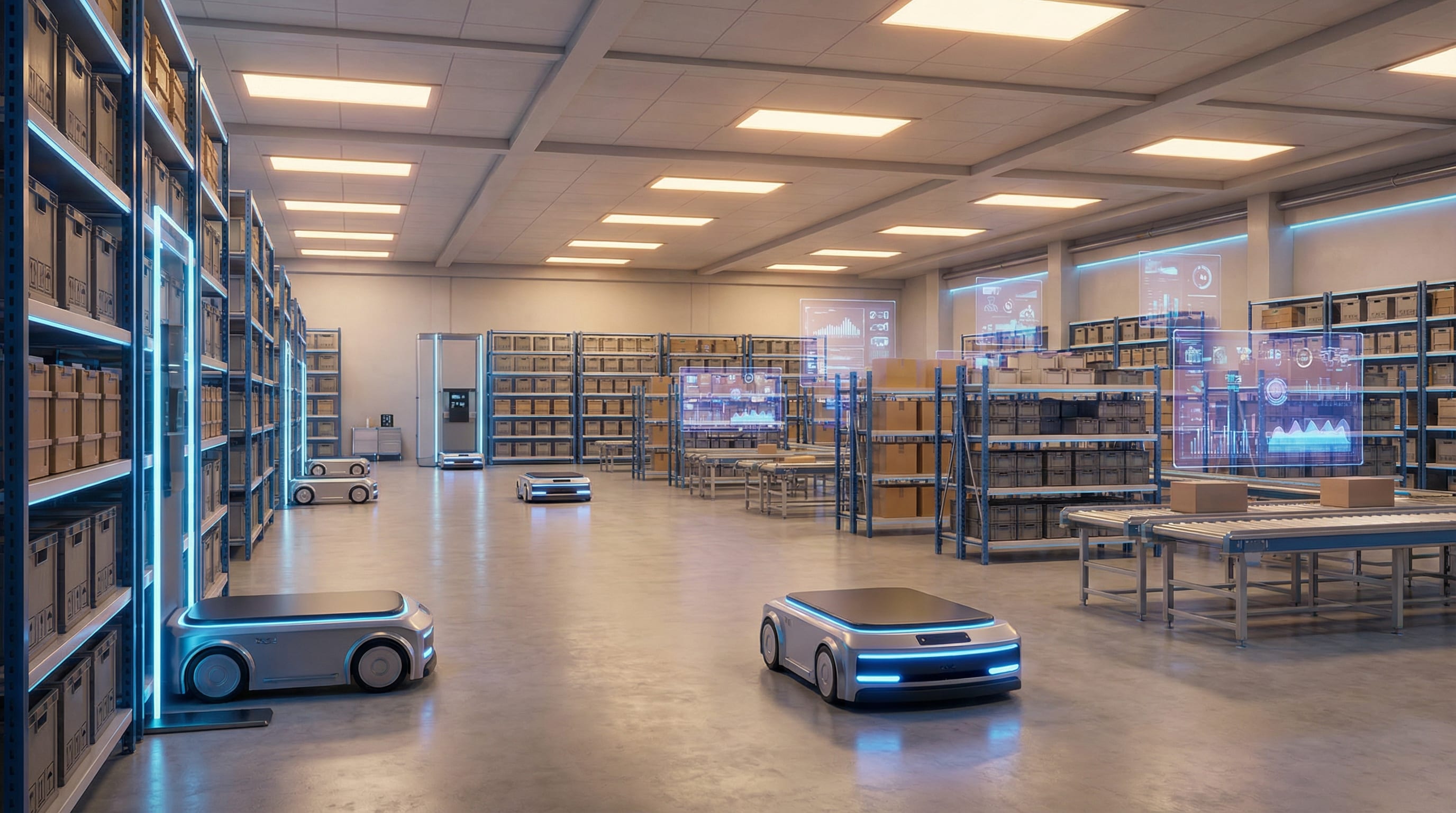
From Storage to Intelligence: How AI Is Redefining Warehouse Management
The warehouse management system has evolved from a simple inventory database into an AI-powered orchestration platform. Here is what that means for your operations.
On this page
The Evolution of WMS: From Inventory Database to AI Brain
A warehouse management system is specialized software designed to oversee, optimize, and execute every warehouse operation -- from the moment goods enter a facility until they are shipped to their final destination. But the WMS of 2025 bears almost no resemblance to the inventory tracking tools of a decade ago.
Traditional warehouse management relied on manual processes: paper clipboards, workers searching shelves under dim fluorescent lighting, and spreadsheets that were outdated the moment they were saved. These legacy methods suffered from delays in locating available storage spaces, lack of real-time shelf data, and frequent overflow situations. Error rates hovered around 10-15%, and managers operated on guesswork rather than data.
Today, AI and machine learning have transformed the WMS into a predictive, autonomous orchestration platform -- one that does not merely track what is in the warehouse, but anticipates what should be there, routes robots to retrieve it, and validates quality using computer vision before it leaves the dock.
This evolution is not incremental -- it is transformational. Surveys indicate that 73% of industry leaders plan to integrate AI solutions into their warehouse operations within the next five years, while experts forecast a 40% increase in overall logistics productivity by 2035 driven by these technologies.
Market Growth & Trends
The global WMS market is experiencing explosive growth, driven by e-commerce expansion, cloud adoption, and the push for frictionless omnichannel delivery. Multiple market research firms place 2024 baseline valuations between $2.82 billion and $4.69 billion, with compound annual growth rates projected between 10% and 19.4%.
North America currently holds the largest market share at approximately 35%, valued between $747 million and $1.65 billion in 2024. Europe follows with an estimated 30% share. But the Asia Pacific region is unanimously identified as the fastest-growing market globally -- driven by thriving e-commerce sectors in China, India, and Southeast Asia.
The third-party logistics (3PL) segment dominates by end-user, as 3PL providers manage multi-client warehouses requiring highly flexible and scalable WMS software to meet diverse fulfillment demands.
WMS Market Growth Trajectory (2024-2034)
Predictive Demand Forecasting: The End of Guesswork
Traditional demand forecasting relied on historical sales data and gut instinct -- a model that crumbles when supply chains face geopolitical disruptions, weather events, or sudden consumer trend shifts. AI-powered WMS platforms have fundamentally changed this equation.
Using vast data lakes of historical sales, market trends, seasonality, and external indicators like weather patterns and social media sentiment, machine learning algorithms can anticipate demand shifts with a precision that was previously impossible.
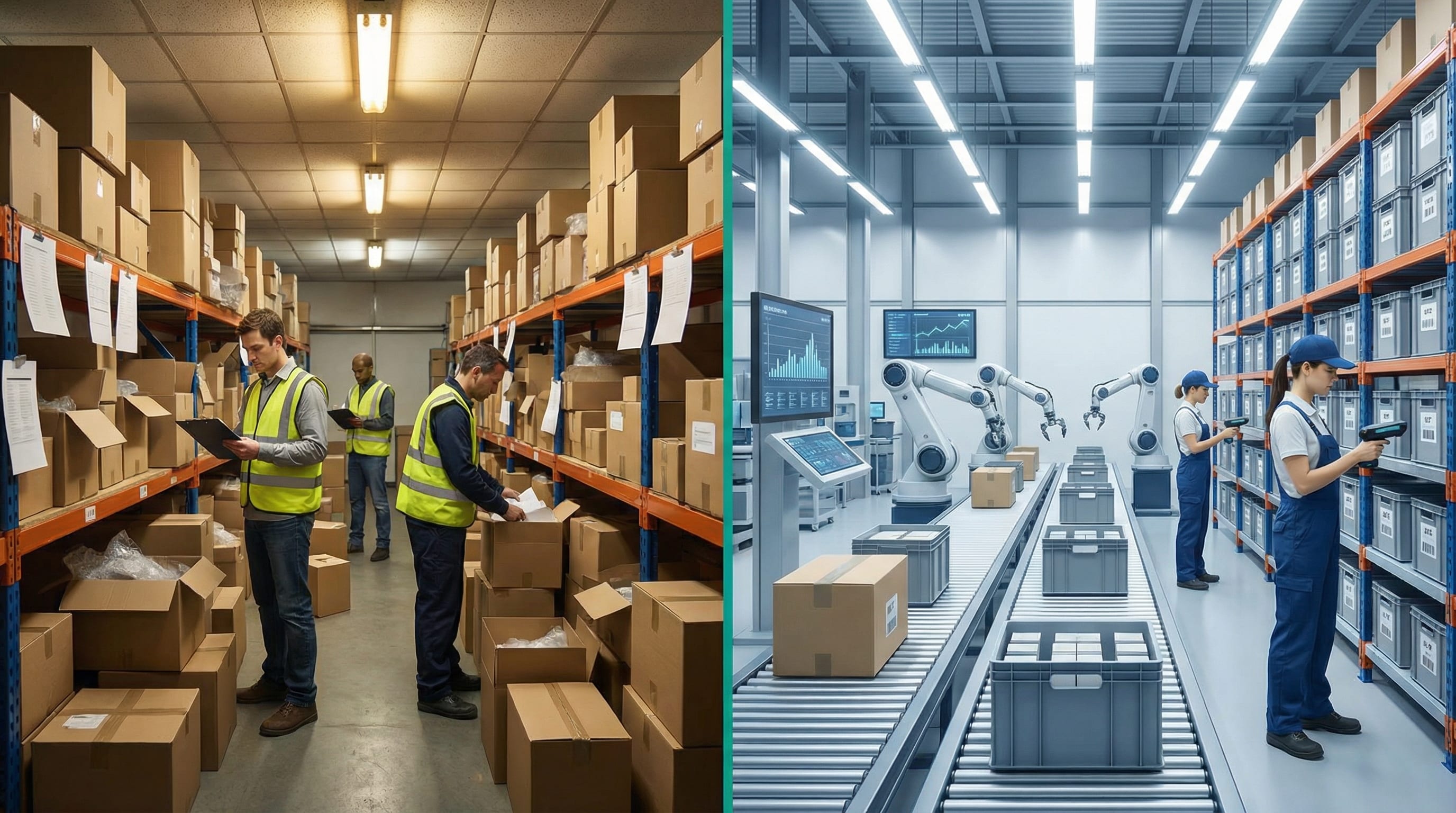
Manual Forecasting
- Based on last year's sales data -- misses new trends
- 85-90% inventory accuracy with manual counts
- Stock-outs discovered only when shelves are empty
- 75-100 picks per hour with static routes
- Seasonal peaks cause chaos and overtime
- Reactive restocking after shortages occur
Predictive Orchestration
- Real-time data fusion from multiple signals
- 98-99% inventory accuracy with continuous tracking
- Stock-outs predicted 2-4 weeks in advance
- 150-200 picks per hour with dynamic routing
- Demand spikes anticipated and pre-positioned
- Proactive replenishment before shortages hit
The result is not incremental improvement -- it is a category shift. WMS platforms with integrated AI have been shown to reduce stock-outs by 30-50% through improved visibility and optimized safety stock levels, while simultaneously cutting overstocking that ties up working capital.
Computer Vision: Eyes That Never Blink
Quality assurance and inventory verification have traditionally been the domain of human inspectors -- workers who fatigue after hours of repetitive scanning. Computer vision is changing this by deploying AI-equipped cameras and sensors that perform automated quality checks, defect detection, and inventory validation with superhuman consistency.

Human Error at Scale
Manual quality inspection catches only 80-85% of defects. Fatigue and repetition cause error rates to spike during peak shifts. Mislabeled inventory cascades into wrong shipments and costly returns.
AI Visual Intelligence
Camera arrays mounted on conveyors and robotic arms use machine learning models to scan every item in real time. The system checks dimensions, labels, barcodes, and physical condition against the expected specification.
Near-Zero Defect Pass-Through
Computer vision achieves 99.5%+ detection accuracy with zero fatigue degradation. Shipping error rates drop by 70-90%, and each defect is logged with timestamp and image for audit trail.
Beyond quality control, computer vision enables continuous inventory tracking without physical audits. RFID, GPS tagging, and IoT sensors combined with visual AI create a live digital twin of every item in the warehouse -- practically eliminating the need for periodic stocktakes that traditionally shut down operations for days.
Autonomous Mobile Robots: The New Warehouse Workforce
Autonomous Mobile Robots (AMRs) represent the most visible transformation in modern warehousing. Unlike fixed conveyors, AMRs navigate warehouse floors independently, transporting goods while dynamically avoiding obstacles and human workers. They are increasingly equipped with display screens to guide human pickers and can adapt their routes in real time based on shifting priorities.
The 2025 trend is clear: warehouses are moving toward flexible automation -- intelligent robotic solutions that learn from operational data and adapt to varying SKUs and fluctuating demand profiles without constant reprogramming.
33% Faster Cycles
AMR deployment reduces order cycle times by a third, dramatically accelerating the path from order placement to shipment.
21% Higher Throughput
Warehouses deploying AMRs alongside human pickers achieve 21% more throughput without adding floor space or additional shifts.
Safer Operations
AMRs equipped with LiDAR and proximity sensors navigate around workers safely, reducing workplace accidents from forklift operations.
Lower Labor Costs
By handling transport tasks, AMRs free human workers for higher-value activities like quality inspection and exception handling.
Vertical Space Utilization
Automated Storage and Retrieval Systems (AS/RS) paired with AMRs maximize vertical space, enabling goods-to-person operations in dense storage.
24/7 Operations
Robots do not take breaks, call in sick, or suffer productivity drops at 3 AM. They enable true round-the-clock fulfillment capacity.
The Numbers That Matter
The financial case for AI-powered WMS is not theoretical -- it is backed by hard data from thousands of deployments worldwide. Small to medium-sized businesses deploying their first barcoding WMS typically achieve a positive ROI ranging from 25% to 300% within the first year, with most realizing positive returns within 6 to 9 months.
Key Performance Benchmarks
- Labor Efficiency: 15-30% improvement through optimized picking routes and automated workflows. Leading WMS operations achieve 150-200 picks per hour versus 75-100 in manual environments.
- Travel Time Reduction: WMS-driven route optimization cuts warehouse worker travel distances by 25-40%.
- Error Reduction: Barcoding and WMS logic reduce picking and shipping error rates by 70-90%.
- Inventory Accuracy: From 85-90% with manual methods to 98-99% with modern WMS and cycle counts.
- Fulfillment Costs: Up to 50% reduction in fulfillment costs with comprehensive automation.
- Stock-Outs: 30-50% reduction through improved visibility and optimized safety stock levels.
Investment returns are routinely measured using Internal Rate of Return (IRR), which for WMS projects typically ranges between 25-50% -- a rate that exceeds most corporate investment benchmarks.
Ready to Transform Your Warehouse Operations?
Let Axiom X help you design and implement an AI-ready warehouse management strategy tailored to your business needs.
Get a Free ConsultationWMS in the UAE: A Digital Logistics Renaissance
The UAE -- and the broader GCC region -- is experiencing a localized surge in WMS adoption. The GCC WMS market was valued at $150 million in 2024 and is projected to reach $493.4 million by 2032, growing at a CAGR of 16.2%. The UAE market specifically is expanding at an impressive 18.7% CAGR.

Government-Led Digital Transformation
Initiatives like the National Innovation Strategy, Operation 300bn, and Smart Dubai are building world-class digitized logistics hubs as part of the UAE's economic diversification away from oil dependency.
E-Commerce Explosion
Exponential growth in regional e-commerce penetration among affluent urban populations has compelled retailers and logistics providers to deploy sophisticated WMS platforms for omnichannel fulfillment and rapid delivery.
Free Zone Ecosystems
Dubai's port-centric and free zone logistics operations require WMS solutions capable of managing complex, multi-client inventories and cross-border billing structures across JAFZA, DAFZA, and other zones.
Automation Infrastructure Boom
UAE facilities have a high penetration rate of AMRs, automated storage, and robotics. Global vendors like Dematic have expanded their Dubai presence to service this infrastructure investment wave.
Dubai's status as a global transit hub means its warehousing ecosystem is heavily port-centric. The increasing reliance on outsourced logistics and third-party fulfillment within free zones drives demand for WMS solutions that can handle the unique complexity of multi-tenant, multi-currency, and cross-border operations.
Building Your AI-Ready Warehouse Stack
Choosing the right WMS is not just a technology decision -- it is a strategic one. History has shown that poorly executed implementations can be devastating. In 2015, athletic retailer Finish Line botched a simultaneous WMS and order management system launch, resulting in $32 million in lost sales in a single quarter, the closure of 150 stores, and the resignation of the CEO.
Use this decision framework to evaluate your readiness:
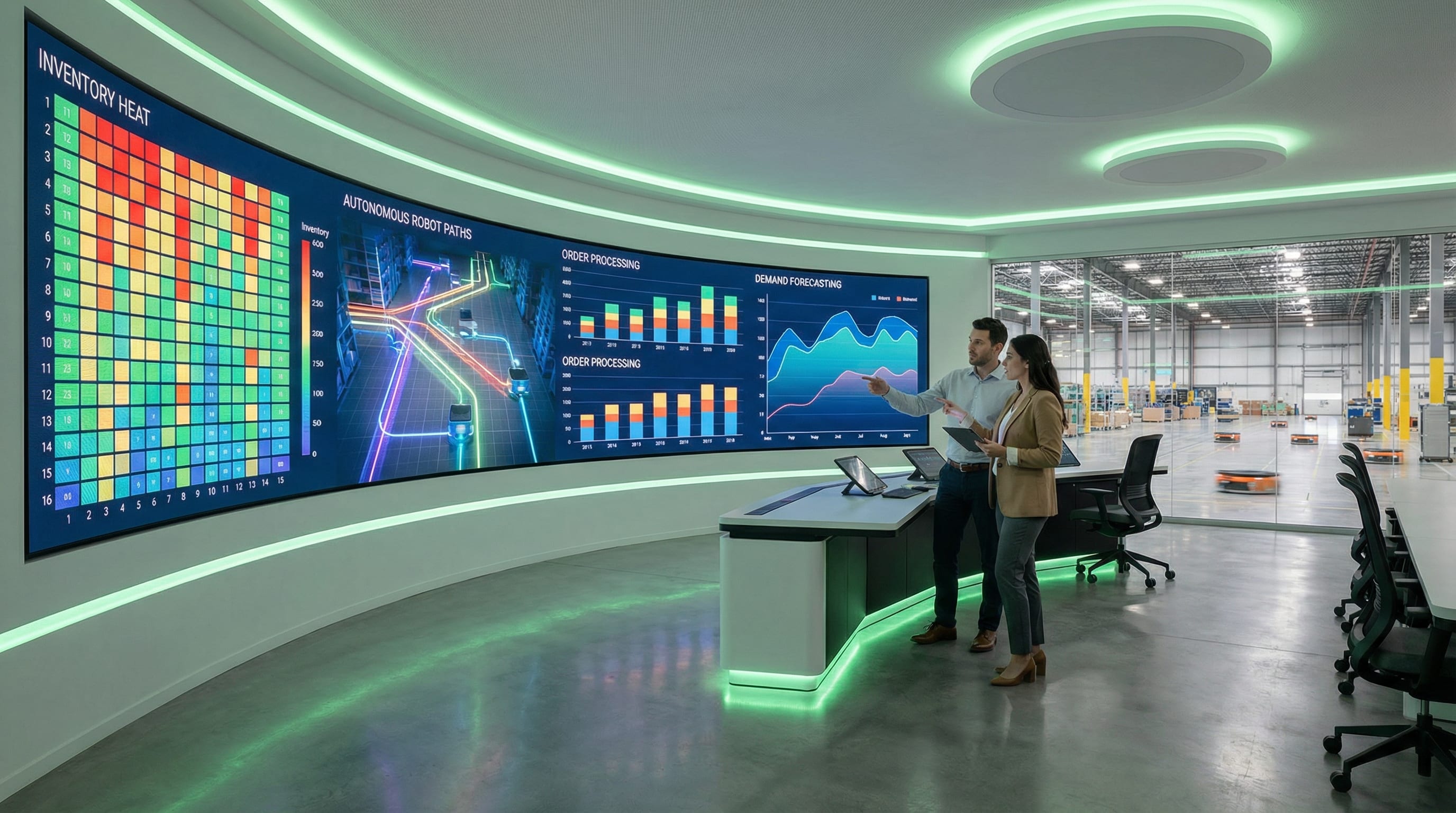
The Autonomous Future
The warehouses that embrace highly flexible, AI-informed management systems will establish a fortified, resilient, and exceedingly efficient operational posture capable of dominating the future logistics landscape.
Industry consensus from leading logistics research firmsBy 2030, the global WMS market is expected to surpass $10 billion, serving as the foundational software layer for fully autonomous warehouses. Several converging trends are shaping this future:
- Dynamic demand forecasting will reach unprecedented importance as global supply chains face unpredictable geopolitical and environmental disruptions. WMS platforms will increasingly ingest real-time external data streams to pivot operations proactively.
- Continuous inventory tracking via RFID, GPS, and IoT monitoring will make physical audits obsolete. Every individual part and product will be tracked continuously, practically eliminating mystery inventory losses.
- Flexible automation will mature from early adopters to mainstream. Robots that learn from operational data and adapt to varying SKUs without reprogramming will become the standard, not the exception.
- Digital twins will provide complete virtual replicas of warehouse operations, enabling managers to simulate changes -- from layout modifications to staffing models -- before implementing them in the physical world.
The warehouse of 2030 will not merely be managed by software -- it will be orchestrated by intelligence. The question is not whether to adopt AI-powered WMS, but how quickly you can implement it before your competitors do.
Frequently Asked Questions
A warehouse management system (WMS) is specialized software that oversees and optimizes all warehouse operations -- from receiving and storage to picking, packing, and shipping. It is important because it replaces error-prone manual processes with automated workflows, providing real-time inventory visibility, reducing fulfillment errors by up to 90%, and enabling data-driven decision making that directly impacts your bottom line.
WMS costs vary widely based on deployment model. Cloud-based solutions typically run $100-500 per month per user, while on-premises Tier 1 systems can require $500K-2M+ in initial investment. However, the ROI is substantial: most businesses see positive returns within 6-9 months, with first-year ROI ranging from 25% to 300%. Key savings come from labor efficiency (15-30% improvement), error reduction (70-90%), and inventory optimization.
AI transforms WMS in three key areas: (1) Predictive analytics for demand forecasting, allowing proactive inventory positioning rather than reactive restocking. (2) Computer vision for automated quality inspection and continuous inventory tracking without manual audits. (3) Dynamic optimization of picking routes, labor allocation, and robot coordination in real-time. Together, these capabilities can boost overall logistics productivity by up to 40%.
The UAE's WMS market is growing at 18.7% CAGR due to several factors: government initiatives like Smart Dubai and Operation 300bn are digitizing logistics infrastructure; e-commerce penetration among affluent urban populations is surging; and Dubai's free zone ecosystems (JAFZA, DAFZA) require sophisticated multi-client inventory management. Global automation vendors are expanding their UAE presence to service this infrastructure boom.
The three biggest risks are: (1) Simultaneous system launches -- never deploy a WMS and order management system at the same time, as Finish Line's $32M disaster proved. (2) Poor change management -- inadequate training causes low adoption and productivity crashes. (3) Legacy system integration issues -- connecting a new WMS with existing ERP and TMS platforms can extend timelines and inflate budgets. Mitigate these with phased rollouts, extensive testing, strategic overstaffing at launch, and maintaining a legacy system rollback option.
For most businesses, cloud-based (SaaS) WMS is recommended. It offers lower upfront costs, faster deployment, automatic updates, and easy scalability during seasonal peaks. On-premises is better for large enterprises requiring maximum data control, deep customization, or regulatory compliance that restricts cloud hosting. Hybrid options also exist, keeping core data local while leveraging cloud for multi-site visibility and peripheral functions.
Sources & References
- Polaris Market Research -- Warehouse Management System Market Size, Share, Growth Analysis (2024-2034). Valued at $4.69 billion in 2024.
- MarketsandMarkets -- Warehouse Management System Market projected to reach $10.04 billion by 2030, CAGR 17.1%.
- Market Research Future -- WMS market valued at $4.39 billion in 2024, projected to $12.50 billion by 2035.
- Credence Research -- Global WMS market valued at $2.82 billion in 2024, CAGR 19.04%.
- PS Market Research -- GCC WMS market valued at $150 million in 2024, projected to $493.4 million by 2032.
- Grand View Research -- Middle East WMS market data and UAE CAGR of 18.7%.
- Finale Inventory -- WMS ROI analysis: 25-300% first-year ROI, positive returns within 6-9 months.
- Tejas Software -- WMS KPI benchmarks: 150-200 picks/hour, 98-99% inventory accuracy, 25-50% IRR.
- ExploreWMS -- Finish Line WMS disaster case study: $32M in lost sales, 150 store closures.
- MAU Workforce Solutions -- Kimberly-Clark SAP EWM implementation: 67% downtime reduction, 90% shipping error reduction.
Let's talk scale.
Whether you're looking to optimize delivery, centralize operations, or unlock new revenue — Axiom X is your growth partner.
Our Headquarters
UAE